
Zack Gilmore (Associate Professor of Anthropology) and Zoe Milburn (former student)
Museums vary widely in terms of the kinds of collections they house, from ancient artifacts and priceless artworks to recent ephemera and niche curiosities. At a fundamental level, however, museums in general may be considered repositories of historical knowledge. Their collections provide insights into past people, events, and attitudes that a community, for one reason or another, has deemed worthy of remembering. As a result, there is some bit of irony involved when an entire museum—by definition, a bastion of collective memory—is forgotten itself. Such was the case for the Thomas R. Baker Museum of Natural History, an important piece of the Rollins campus and local Winter Park community, for more than 60 years.
Museum Origins
The Baker Museum was, in many respects, born of tragedy. The museum’s story begins early in the morning of December 2, 1909, when an alarm bell sounded on Rollins’ campus. Students spilled out of their rooms to find smoke billowing out of Knowles Hall, one of the primary academic buildings on campus at the time. Quickly, a hose line was formed in a valiant effort to save the building and prevent the fire’s spread to other structures. Despite the best efforts of those involved, however, Knowles was rapidly engulfed in flames. Only thirty minutes after the initial alarm, one of the exterior walls collapsed, and within a few hours it was clear that the building would be a complete loss.[1]
The first major structure on campus, Knowles Hall had been constructed in 1886. By 1909, it housed the chapel, the business department, classroom and equipment for physics, chemistry, and biology, and perhaps most significantly, an extensive and largely irreplaceable collection of natural history specimens that had taken decades to assemble and functioned as a campus museum of sorts[2] [3]. The building’s destruction was a major setback for the still young college, so much so that there was considerable speculation about whether Rollins would ultimately survive the event.
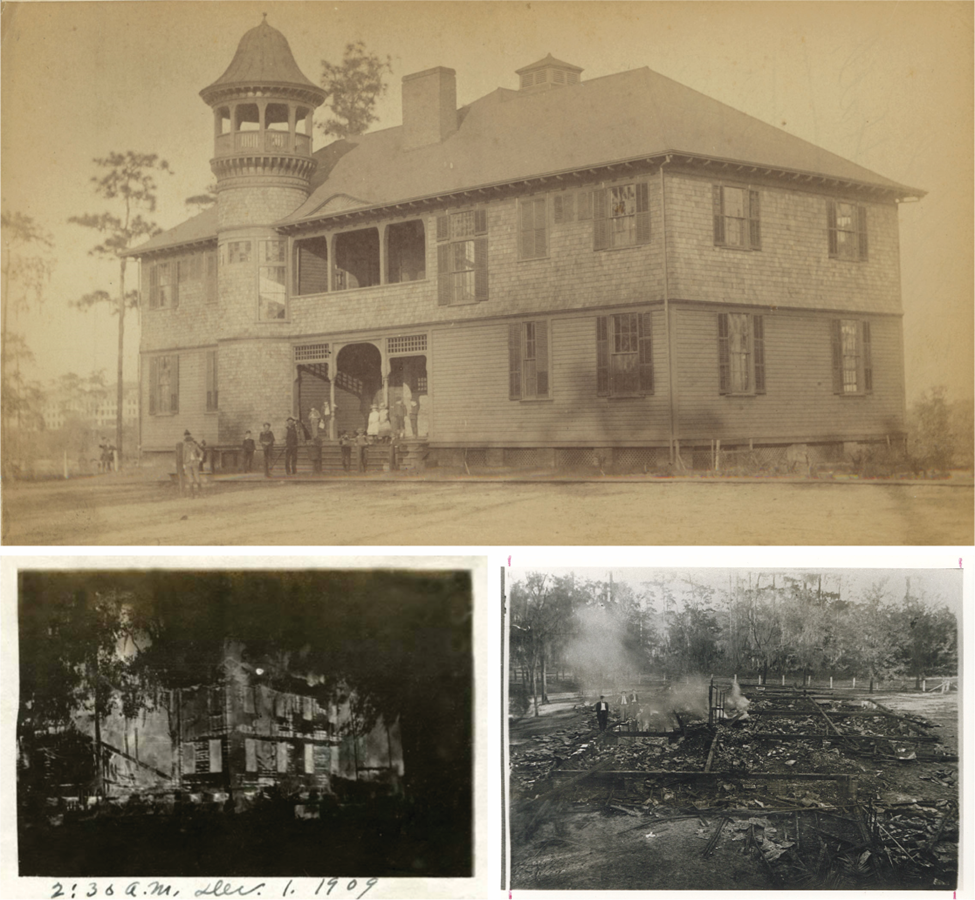
On a personal level, the impact of the fire was most keenly felt by long-time Professor of Natural Science, Dr. Thomas Baker. Born in 1857, Baker joined the Rollins faculty in 1889 and played a major role in the initial development of the college’s science program. By the time of the fire, he had spent more than twenty years accumulating the equipment and collections that were destroyed in just a few hours’ time. Baker’s devastation, however, was apparently soon overcome, as barely a month had passed before a plan was unveiled to not only replace Knowles but also to rebuild and upgrade the lost natural history collections, with the ultimate goal of instituting a proper natural history museum. It was Baker’s hope that the museum “would grow into an interesting and valuable adjunct to the college and become a credit to the institution and to the community.”[4]
With that goal in mind, Baker made broad appeals for donations via posters, letters, and newspaper ads. These requests were directed toward individuals and institutions around the country, including Rollins faculty and students, private collectors, researchers, universities, and science museums.[5] They solicited donations of museum-quality specimens of virtually any type but specifically singled those related to the natural and cultural history of Florida.
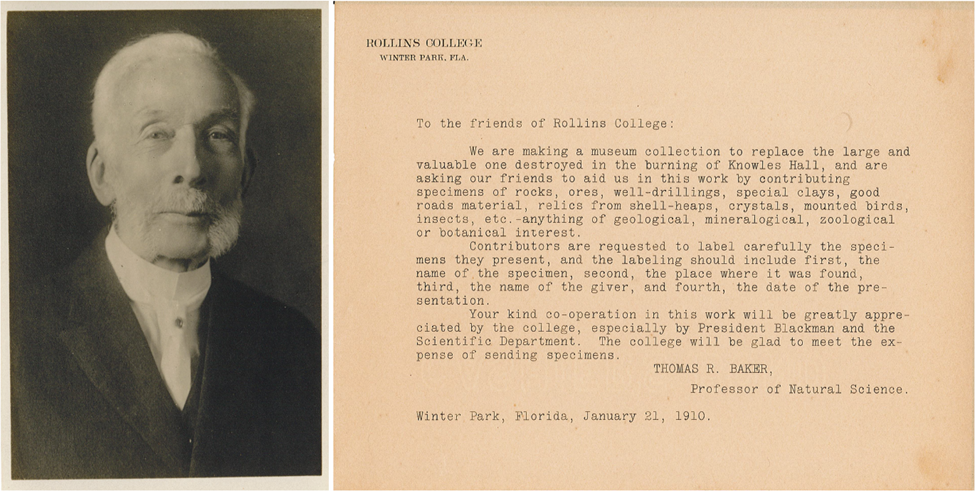
The response to Dr. Baker’s requests was overwhelmingly generous, and quickly, specimens began arriving from around the country, their number approaching 10,000 within the first decade.[6] Notable early donors to the museum included the U.S. National Museum, Johns Hopkins University, the U.S. Treasury, the Carnegie Marine Laboratory, the Buffalo Society of Natural Sciences, Oberlin College, Clarence Bloomfield Moore of the Philadelphia Academy of Natural Sciences, and many others. Among their diverse contributions were natural history collections containing minerals, ores, fossils, snakeskins, fishes, insects, shells, corals, and botanical specimens, along with an eclectic array of cultural artifacts including Native American pottery, arrowheads, rare coins, guns and ammunitions, Civil War relics, antique books, and historical photographs.[7]
These early gifts formed the nucleus of the new museum, which by 1913 had been dubbed the Thomas R. Baker Museum of Natural History.[8] This new museum was housed on the second floor of the newly constructed Knowles Hall II building, located on the spot currently occupied by Olin Library. In 1911, Dr. Baker retired from teaching and became the first director of the Baker Museum, a post in which he served until his death in 1930.
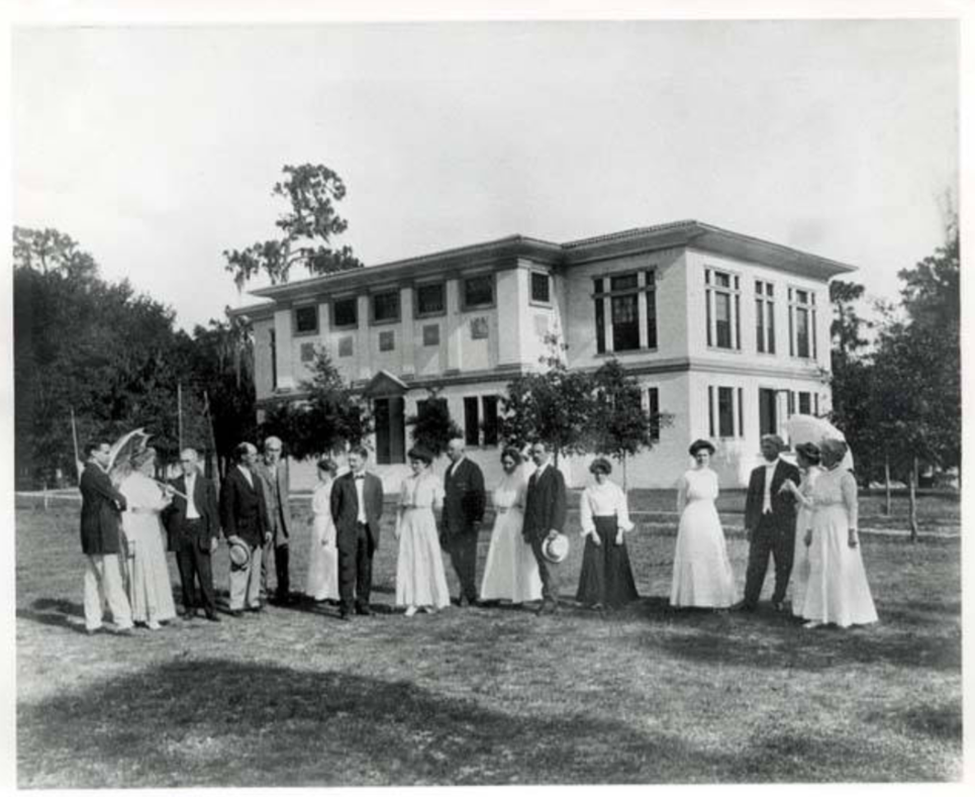

The Baker Museum remained in Knowles Hall II for more than half a century. For much of that time, specimen donations continued to pour in, and the scale of the museum’s collections continued to expand, eventually exceeding 20,000 individual objects. Among the notable early donations were an ancient Roman sword and sheath, granite from the famed Temple of Luxor in Egypt, and a bit of lichen collected by famous 19th-century naturalist Louis Agassiz. The size and remarkable quality of the museum’s growing collections were clearly a source of pride for college, as news of newly acquired artifacts were featured prominently in early issues of various Rollins publications including The Sandspur, The Rollins Alumni Record, and Rollins College Bulletin.
In short order, the collections began to outgrow the space allotted for them, and preliminary discussions were held to either construct a new museum building or to relocate the collections to a larger existing space. In 1939, an apparent solution to the space dilemma was presented when Rollins was afforded the opportunity to purchase the Aloma Country Club building and 3 acres of land at the corner of Aloma Ave. and Lakemont Ave.[9] for $3,000. This property was immediately designated the future home of the Baker Museum, and blueprints were even drawn up for how to structure dedicated spaces for exhibition, curation, and archival work. However, the scope of the repairs and renovations necessary to make the former country club suitable for museum use ultimately proved cost prohibitive. The building was signed back over to the City of Winter Park in 1945 and eventually demolished to make way for the Winter Park Hospital.[10]
In the end, the Baker Museum remained in Knowles Hall II until 1983, when that building was torn down to permit construction of Olin Library. By that point, the museum had lost much of its administrative and faculty support, and its overall role within the college had long since diminished. Following the museum’s closure, the bulk of its extensive collections were dispersed among various institutions. It is unclear how many paper records typically associated with museums (e.g., donor files, accession records, inventories, etc.) originally existed but almost none are to be found today. Perhaps because of this dearth of information, the Baker Museum seems to have faded rather quickly from Rollins’ collective memory, receiving virtually no mention in subsequent treatments of the college’s history.
Baker Museum Collections
After the Baker Museum’s closure, some of the artifacts it housed were transferred to other entities on Rollins campus, including the Cornell Fine Arts Museum (now the Rollins Museum of Art [RMA]) and the Beal-Maltbie Shell Museum. Some additional natural history specimens were incorporated into the teaching collection of Rollins’ Environmental Studies program and eventually donated to other institutions such as the Florida Museum of Natural History and the Oakland Nature Preserve and Terra Firma.
In 1983, what remained of the Baker Museum’s archaeological collections (around five hundred artifacts) was packed into boxes and moved into storage at the Park Avenue Building north of campus by Rollins Professor of Archaeology, Dr. Marilyn Stewart. They remained there until 1988, when construction of the Archaeology Lab in the Cornell Social Science building was completed. Upon Stewart’s retirement in 2005, with no other Rollins faculty member or academic department willing to curate the artifacts, the entire Baker Museum archaeological collection was transferred to the RMA, where it is still housed. Beyond these specific collections, however, the precise fate of most of the tens of thousands of Baker Museum specimens remains unknown.
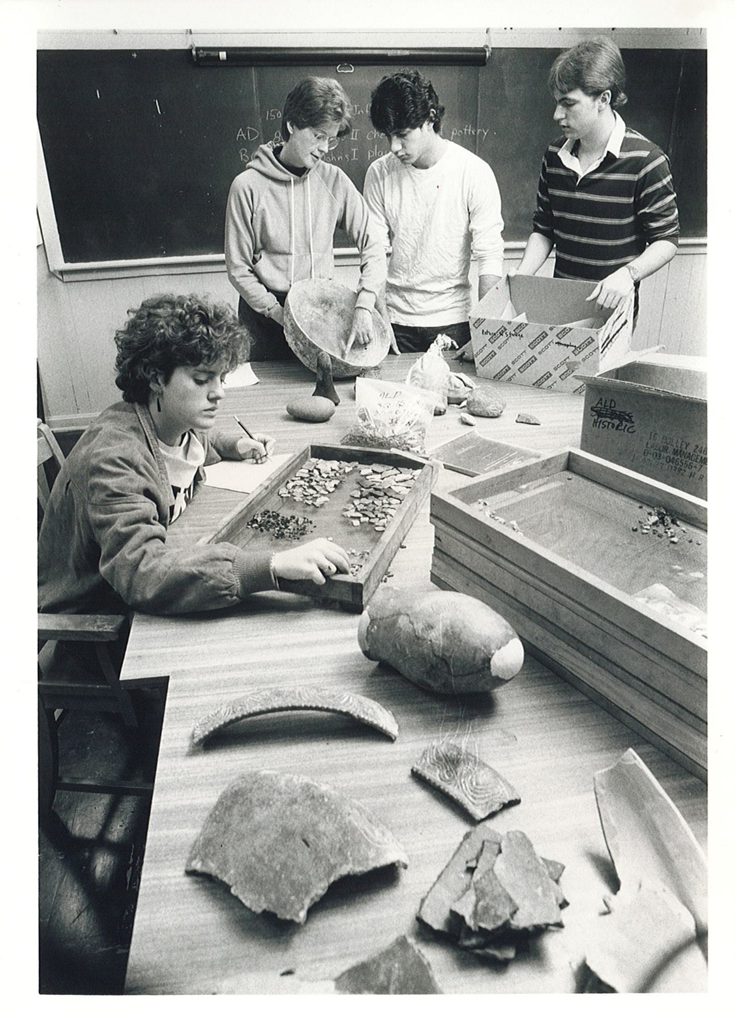
Dr. Marilyn Stewart and students examining Baker Museum artifacts and other specimens in the Rollins College Archaeology Lab (Photo: Rollins College Archives)
Much like the institution as a whole, the Baker Museum archaeological collection had, until recently, been mostly forgotten. Tucked safely into the museum’s vault and largely outside the expertise of recent staff, almost none of the artifacts had been studied or publicly displayed since they sat on shelves at Knowles Hall II in the early 1980s. In fact, few details existed even regarding the size and specific content of the collection.
That began to change in the Fall of 2019. After months of sporadic discussions between then-Assistant Professor of Archaeology, Dr. Zack Gilmore, and RMA curators Amy Galpin and Dr. Gisela Carbonell, a decision was made to begin work on a Fall 2020 exhibition featuring select artifacts from the remaining Baker Museum collection. The exhibition, ultimately titled “Storied Objects: Relics and Tales of the Thomas R. Baker Museum,” was a truly collaborative effort, co-curated by Dr. Gilmore and Associate Professor of Classical Art and Archaeology, Dr. Robert Vander Poppen. It also benefitted from valuable contributions made by students across multiple Rollins classes, including Digital Methods in Art History and Archaeology and Public Archaeology, who spent significant time documenting the collection, reviewing pertinent records at the Olin Library Archives and the RMA, completing condition reports, researching individual artifacts, and contributing to initial stages of the exhibition design and label text.
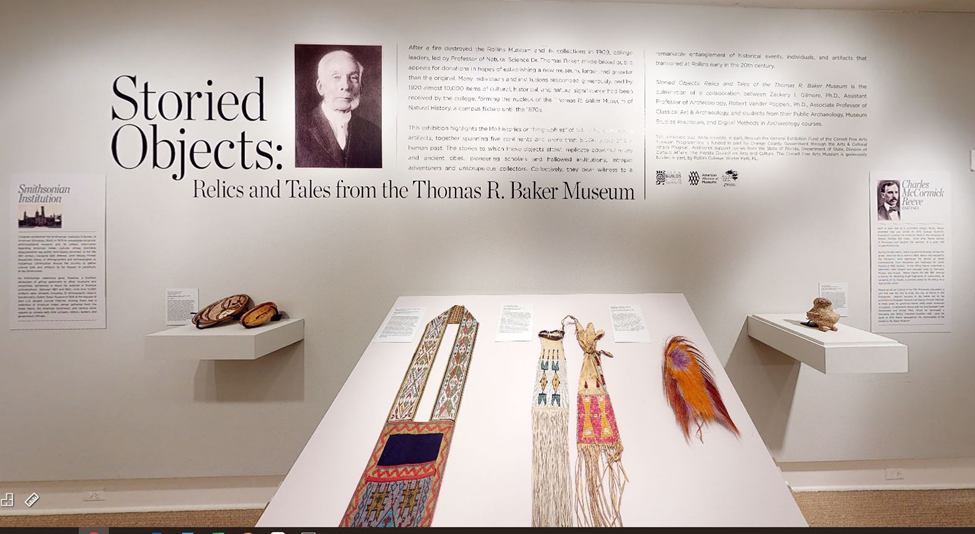
“Storied Objects” was designed to not only highlight the aesthetic and cultural significance of exhibited pieces but also to dig deeply into the history of the collection, with particular emphasis on the stories of how so many remarkable artifacts with such disparate origins all ended up at a museum in Central Florida. This concentration on object provenance led naturally to a focus on the artifacts’ donors as the people ultimately responsible for their assembly, along with a critical examination of the Baker Museum’s place within larger discussions regarding colonialism, museum ethics, and ownership of the past.
Ultimately, several individual donors—along with their respective artifacts—were selected for inclusion in the exhibition primarily on the basis of their potential to both help tell the story of the Baker Museum and contribute to these broader discussions. Among those featured was Edgar J. Banks (1866-1954), a German-trained archaeologist who was appointed field director of the University of Chicago excavations at the Iraqi site of Bismya (ancient Adab) in 1903 but later removed from his position after being accused of looting antiquities from the site. Banks subsequently returned to the U.S., where he toured the country lecturing on Mesopotamian archaeology, bought and sold thousands of artifacts on the antiquities market, and even served as a movie consultant to Cecile B. DeMille.[11] Banks retired to Central Florida in 1921, and following his death, his remaining collection of artifacts was donated to the Baker Museum. Included in this extraordinary donation were numerous cuneiform tablets, an assemblage of mortuary objects from ancient Egypt, and a bronze doorknocker from the Roman city of Pompeii.[12]
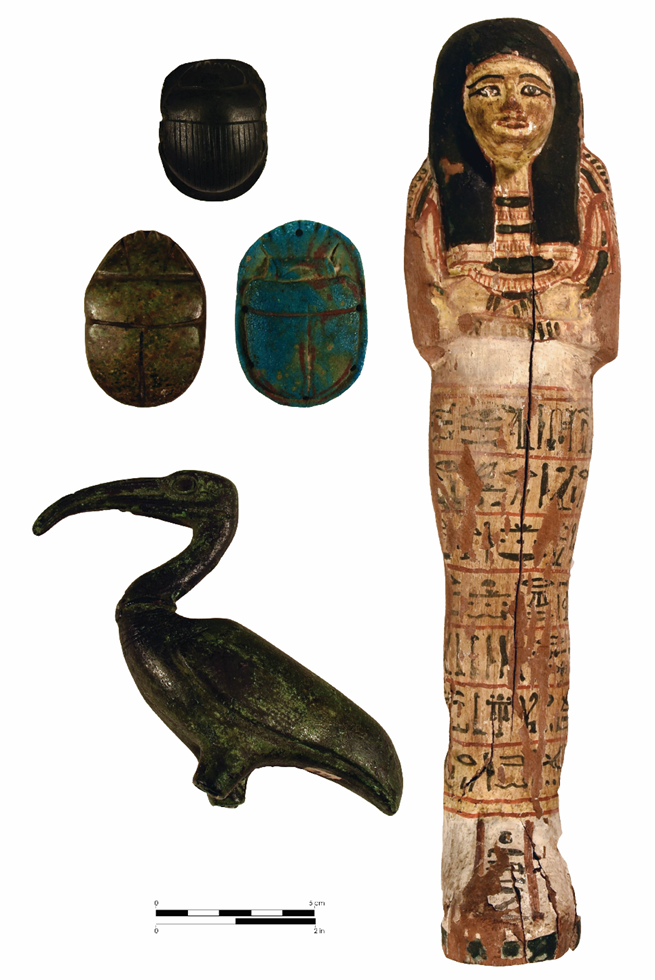
Ancient Egyptian burial objects donated to the Baker Museum by Edgar Banks (Objects curated at the Rollins Museum of Art; Photographs by Zack Gilmore)
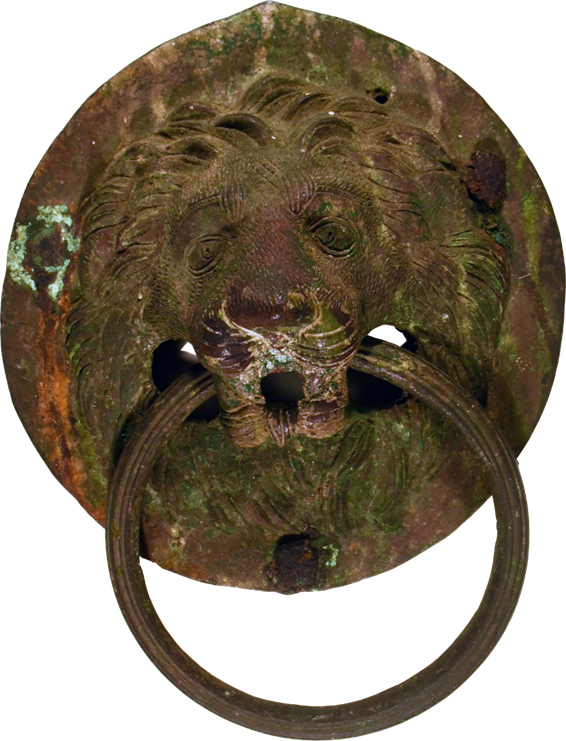
Bronze doorknocker from the ancient Roman city of Pompeii (Object curated at the Rollins Museum of Art, Photographs by Zack Gilmore)
Another notable donor highlighted in the exhibition was Minnesota state legislator and hero of the Spanish-American war, General Charles McCormick Reeve (1847-1947). During the late 19th century, Reeve travelled extensively around the world, making a point along the way to collect small fragments of monuments he visited as souvenirs. Upon his death in 1947, Reeve bequeathed to the Baker Museum dozens of pill boxes containing his mementos, which included such remarkable relics as a fragment of the Sphinx, a mosaic floor tile from Pompeii, and a piece of silk from Voltaire’s waste basket, among many others.[13]


Souvenirs in hand-labelled pill boxes donated to the Baker Museum by General McCormick Reeve, including the bones of an Egyptian mummy (right) and a tile from a mosaic floor at Pompeii (right). (Objects curated at the Rollins Museum of Art, Photographs by Zack Gilmore)
Reeves’ pillboxes were displayed next to artifacts donated by Clarence Bloomfield Moore, noted antiquarian and writer, who explored and excavated (some might say plundered) Native American archaeological sites across the American Southeast. In response to Thomas Baker’s solicitations for museum specimens, Moore donated an assemblage of pre-Columbian ceramic vessels to the Baker Museum that had been excavated from archaeological sites in northwestern Florida.[14]
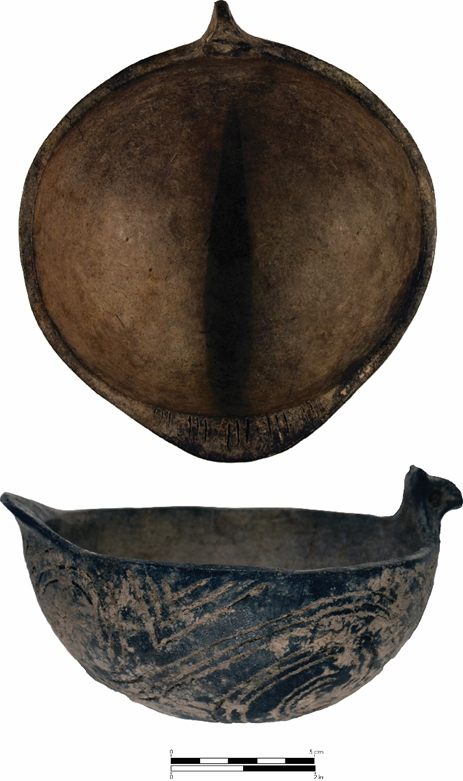
Ceramic bird effigy pot belonging to the Fort Walton culture of Northwest Florida, donated to the Baker Museum by Clarence Bloomfield Moore (Object curated at the Rollins Museum of Art; Photographs by Zack Gilmore)
Ultimately, these artifacts—along with those associated with all the other donations showcased in “Storied Objects”—helped relay the largely forgotten story of Rollins’ Baker Museum, as well as many of the individuals and institutions who contributed to its early development. At the same time, they also helped facilitate important conversations surrounding the ethically fraught history of Western museums and the strategies through which they accumulated their collections. The collaborative nature of the work involved in researching and designing “Storied Objects,” which involved students, staff, and faculty from Anthropology, Art History, the RMA, and the Olin Library Archives, served to enhance the exhibition’s impact, while also setting up the remaining Baker Museum collections to be a more visible and effective resource for the entire campus community moving forward. For now, these invaluable relics remain safely housed within the facilities of the RMA.
[1] Sandspur, Vol. 16, No. 01, 1910.
[2] Wenxian Zhang, Rollins Architecture: A Pictorial Profile of Current and Historical Buildings (n.d.), 11.
[3] Catalogue of Rollins College (Winter Park, FL: Rollins College, 1898-99), p. 5.
[4] Thomas R. Baker, “The Museum of Rollins College,” 1922. From the Rollins College Archives.
[5] Ibid.
[6] Rollins College Bulletin Vol. XIV, No. 1(Winter Park, FL: Rollins College, June 1921)
[7] Thomas R. Baker, “The Museum of Rollins College,” 1922. From the Rollins College Archives.
[8] Catalogue of Rollins College (Winter Park, FL: Rollins College, 1913-14).
[9] Rollins College Alumni Record (Winter Park, FL; Rollins College, June 1939), p. 4.
[10] Unknown Author, “Aloma Country Club.” From the Rollins College Archives.
[11] Ramsey Campbell, “The Johnny Appleseed of History,” Orlando Sentinel, December 1, 2002.; Karen L. Wilson, Bismaya: Recovering the Lost City of Adab, Oriental Institute Publications Volume 138, (University of Chicago, 2012).
[12] Unknown Author, “List of Antiquities Given to Rollins College by Mrs. E. J. Banks, Eustis, Florida – May 2, 1958.” From the Rollins College Archives.
[13]“Obituary Record of Graduates of Yale Unifersity Deceased during the Year 1946-1947, Bulletin of Yale University 44:1 (New Haven, CT, January 1948). Pete Smith, “Charles McCormick Reeve: Biography,” American Numismatic Biographies, accessed April 1, 2025, https://archive.org/details/2012AmericanNumismaticBiographies.
[14] Jeffrey M. Mitchem, The West and Central Florida Expeditions of Clarence Bloomfield Moore (Tuscaloosa, AL: University of Alabama Press, 1999).