
Written and edited by Rachel Walton and Emma McAdoo
This is part one of a two-part blog post written and edited by Librarian Rachel Walton and Olin Library student worker, Emma McAdoo. It is inspired and informed by the Women at Rollins historical exhibit. All research and writing for the Women at Rollins exhibit was conducted by a team of seven student curators as a part of Dr. Claire Strom’s Fall 2024 Public History class. They are listed here as coauthors and collaborators: Kayleigh Calaway, Faith Chaney, Aislinn Gara Grady, Brynna McDonald, Reilly Merritt, Arianna Pazmino, and Justin Perez. Finally, the College Archives team was essential in researching and creating the exhibit. All sources and images, if not attributed otherwise, come from the Rollins College Archives’ rich collections.
Rollins College is proud to present this two-part blog series, “Nevertheless, She Persisted,” with the aim of exploring the historical experiences of women – both on a national scale and within our own Rollins College community.
This first installment takes a broad look at the history of women’s rights in the United States from 1850 to 2015. It traces the evolution of women’s rights, highlighting key milestones such as the passage of the 19th Amendment, the impact of World War II on women’s employment, the rise of second-wave feminism, and the ongoing struggles for equality in the 21st century. Part two narrows focus to highlight the experiences of women at Rollins from its founding in 1885 to the present day, examining challenges faced and celebrating influential female leaders who have shaped the college’s history.
We invite you to join us on this journey through history, to learn from the past, and to be inspired by the resilience and determination of the women who have shaped our world and our college. We hope their stories can remind all of us of the progress we have made and embolden us for the work that still lies ahead.
The Suffrage Movement
The fight for women’s rights in the United States gained momentum in the mid-19th century, largely driven by the abolitionist movement and the push for women’s suffrage. Pivotal moments like the 1848 Seneca Falls Convention marked the beginning of organized advocacy for gender equality, calling for the right to vote. Leaders such as Elizabeth Cady Stanton and Susan B. Anthony were central figures in this movement which formalized into the National Woman Suffrage Association in 1869, later becoming the National American Woman Suffrage Association (NAWSA) in 1890.

Elizabeth Cady Stanton, seated, and Susan B. Anthony, standing on the right. Photo courtesy of the Library of Congress.
Despite the growing support for the suffrage movement, suffragists encountered substantial opposition, so they began to engage in bolder tactics. Susan B. Anthony was arrested in 1872 for trying to vote in her district and then endured a widely publicized trial. This case generated national attention and highlighted the issue of women’s suffrage to the public. Later, in 1913 suffragists organized the first official Women’s Suffrage Processional Protest down Pennsylvania Avenue in Washington DC in an effort to mass organize around the critical issue of voting.
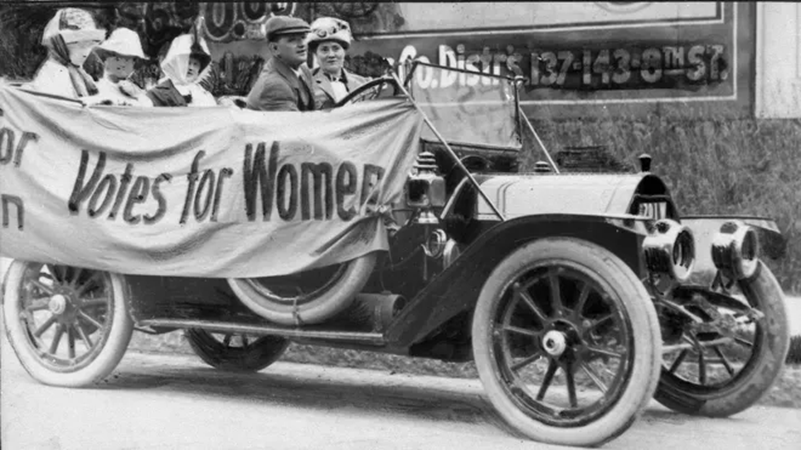
This tireless work ultimately led to the passage of the 19th Amendment in 1920, which granted women the right to vote in federal elections. While this was a monumental victory in American history, Black Americans did not fully secure voting protection until the Voting Rights Act of 1964. Despite the passing of the 15th Amendment in 1870, many states continued to practice racial discrimination at the polls during the Jim Crow era, disenfranchising Black voters and installing high poll taxes as a deterrent.
Women’s suffrage activism in Florida also gained energy during this time. Figures such as Ella C. Chamberlain, who started “The Women’s Suffrage Column” in the Tampa Weekly Tribune in 1892, played crucial roles in advancing gender equality. Chamberlain also founded the Florida Woman Suffrage Association and organized a Women’s Suffrage Convention in Tampa in 1895. Unfortunately, despite such efforts, the U.S. Senate defeated women’s suffrage in 1896 by a 2-to-1 vote. Progress at both the national and local levels would continue to be slow, but suffrage campaigns in Florida and elsewhere persisted.
Continued Advocacy and Progress
After the passage of the 19th Amendment in 1920, women began advocating for broader equality in various sectors, including education, employment, and politics. One significant victory in this area was Hattie Caraway’s election to the Senate from the state of Arkansas in 1931– Hattie was the first woman to serve as a U.S. Senator, though many more would follow in her footsteps. In Florida, Ruth Bryan Owen became the first woman elected to Congress when she won a seat in 1928. She represented Florida’s 4th district in the House of Representatives from 1929 to 1933 and later served as the U.S. Ambassador to Denmark. These trailblazing ladies were symbols of the progress women were making in the political sphere.
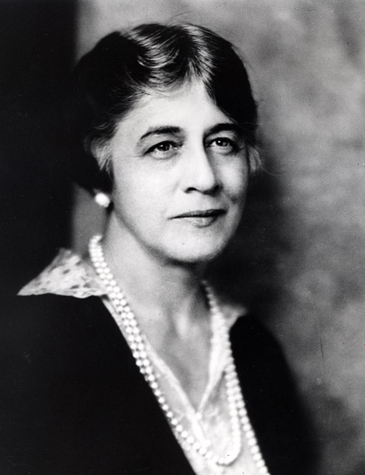
Ruth Bryan Owen, photo taken in 1950.
Despite these milestones, the societal expectations for women in the 1930s and 1940s often confined them to domestic roles. Most women did not work outside the home, and those who did were primarily young and unmarried. The types of work that female professionals might have at this time included childcare and teaching, household and other domestic services like laundry and cleaning, clerical occupations like secretarial roles, and sometimes factory work for women from low-income households living in urban environments.
World War II marked a turning point in female employment. With men serving in the military, women entered the workforce in droves. Women worked in shipyards, factories, and as riveters. They became welders, machinists, and truck drivers, making essential contributions to the war effort. Additionally, women served as nurses, fundraisers, and in administrative positions within the government, such as typists, clerks, switchboard operators, and radio operators — all of which were, of course, in support of the war effort. Furthermore, this period also saw a significant increase in the number of women head-of-households due to the wartime casualties.
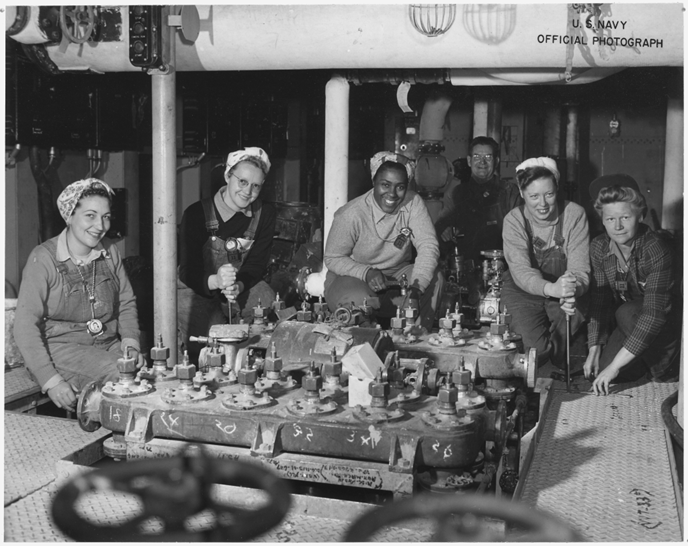
Caption: Women shipfitters working on board the USS Nereus in the U.S. Navy Yard on Mare Island, CA circa 1943. Photo courtesy of the Department of Defense.
While many women returned to traditional roles after the war ended, and the 1950s saw an explosion of suburban housewives with growing families, the seeds of feminism were already planted. The 1960s saw the emergence of second-wave feminism, which focused on reproductive rights, sexual harassment, workplace discrimination, and equal pay. The National Organization for Women (NOW), co-founded in 1966 by Rollins alumna Muriel Fox, alongside national leaders like Betty Friedan and Pauli Murray, played a pivotal role in advocating for these causes.
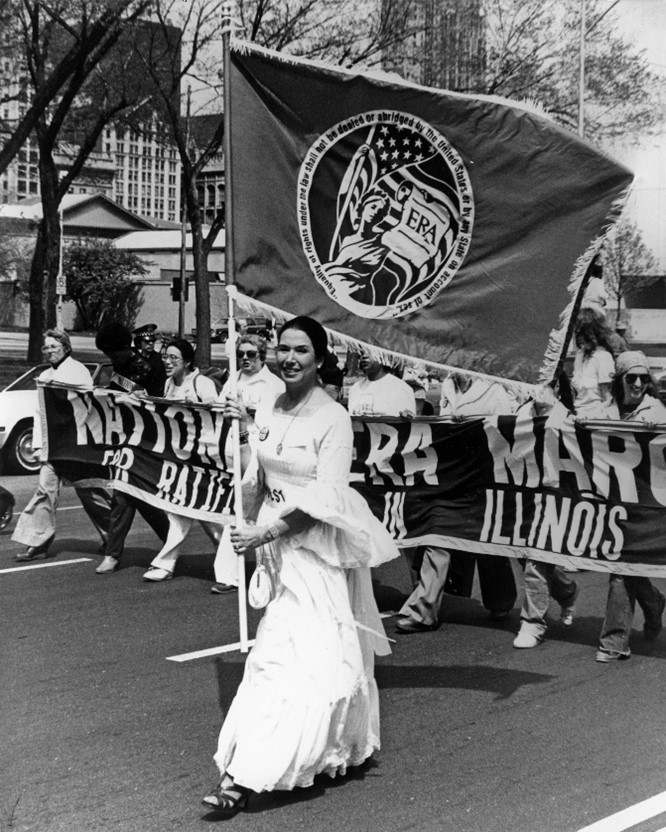
Muriel Fox leads the charge in an Illinois march with the National Organization for Women, advocating for the Equal Rights Amendment (ERA)
Legal victories for women in the 1960s were huge. The Equal Pay Act of 1963 mandated equal pay for equal work; this was a chance to level the playing field for female professionals. In addition, the Civil Rights Act of 1964 prohibited discrimination of any kind and in any sector based on sex or race. And only one year later, in the landmark decision of Griswold v. Connecticut, the Supreme Court legalized birth control for married couples, arguing that any law that prohibited the use of contraceptives violated marital privacy.
In addition to these exciting legislation developments, more and more women were being elected into government positions. By 1963 twenty women were serving as either Senators or Representatives in US Congress. This trend could also be seen at the state government level. Beth Johnson became the first woman elected to the Florida Senate, and she had previously become only the second woman to ever be elected to the Florida House (representing our very own Orange County!) as early as 1958. These victories were part of the growing recognition of women’s roles in governance.
The Modern Feminist Movement
In 1970, NOW organized a national strike to commemorate the anniversary of the 19th Amendment. The strike took many forms across the country, but the largest event was a march down Fifth Avenue in New York City, which drew over 50,000 participants. This diverse crowd included women of all ages, housewives, single women, mothers, daughters, and men in support of women’s rights. The march was also notable for its diversity of political views, with radicals, Black Power advocates, and pacifists joining together. Media coverage of the event was extensive, and NOW’s membership swelled by 50% within months, highlighting the increasing momentum of the feminist movement. This event in some ways foreshadowed the emergence of second wave feminism twenty years later which came to emphasize intersectionality and inclusivity.
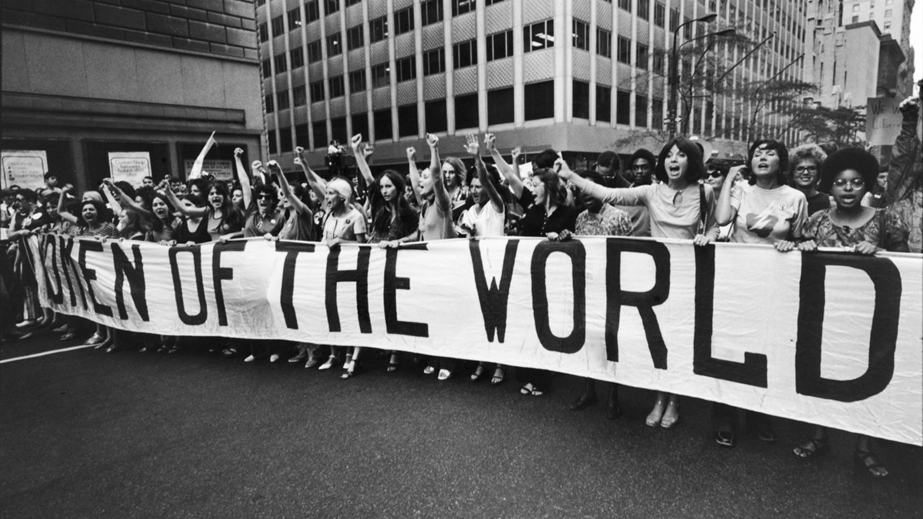
The 1970s and 1980s also saw important legal and social developments for women. In 1973, the Supreme Court’s decision with Roe v. Wade legalized abortion in the U.S., affirming a woman’s right to privacy and to make her own choice about reproducing. Despite this significant ruling, the battle over abortion rights continued at the state level, with the debates over its legality intensifying in the decades that followed. Women’s access to abortion and reproductive healthcare remains a focal point of political debate today and Roe v. Wade was recently overturned in 2022.
These decades saw many “female firsts” in our government systems. In 1977, Patricia Roberts Harris became the first Black woman appointed to a Presidential Cabinet under President Jimmy Carter. And Paula Hawkins, in 1980, became the first woman elected to the U.S. Senate from Florida. However, despite some victories and progress, the Equal Rights Amendment (ERA) failed to gain sufficient support. The ERA, first proposed in the 1920s, was intended to guarantee equal rights under the law for all people, regardless of sex, and was designed to explicitly prohibit discrimination based on sex. In 1972 the ERA was reintroduced in the US Congress and passed. It was then sent to the states for ratification but to become a part of the Constitution it needed to be ratified by three-fourths of the states (38). Despite the Florida House passing the ERA in 1982, the Florida Senate never did; in fact, only 35 states ratified the ERA by 1982. Intense opposition from conservative religious and political organizations in the 1970s and 80s, including the “STOP ERA” campaign led by Phyllis Schlafly, effectively brought ratification of the ERA to a standstill. To this day ERA remains unadopted in law.
The 21st Century and the Future of Feminism
The record number of women elected to Congress and state legislatures in 2018 seems to have changed the discussion around the ERA because it is now back on the nation’s agenda. Female representation in congress has grown steadily since the 1970s and this has deeply impacted advocacy and legislation. As of 1990 nearly 10% of lawmakers were women. By 2010 this number jumped to 25%. On August 26, 2000, President Bill Clinton declared a Women’s Equality Day. Clearly the 2000s saw the election of women in high political office and some recognition of what women contribute to the county.
Women’s representation in powerful and political spaces continued to grow in the 1990s and beyond. Janet Reno became the first woman to serve as the US Attorney General in 1996. Madeleine Albright was the first woman to serve as the United States Secretary of State under President Bill Clinton from 1997 to 2001. Nancy Pelosi was the first woman to be elected as U.S. House Speaker, serving from 2007-2011 and then again from 2019-2023. And there are surely many more “firsts” to report beyond those mentioned here in these exciting years. These victories were significant and a long-time coming.
The 2000s saw the rise in what has been called fourth wave feminism, which focused on issues such as female empowerment, body positivity, LGBTQ+ rights, and the use of social media to combat sexual harassment and violence. The #MeToo movement, which began in 2006 but gained significant traction online by 2017, was a prime example of how popular feminist thought evolved to meet the needs of a new generation of feminists.

While activist Tarana Burke originally coined the phrase “me too” in 2006, it was the year of the Women’s March in 2017 when actress Alyssa Milano’s “me too” social media post started a domino effect, and survivors stepped forward en masse. Within 24 hours, more than 12 million women who had also experienced sexual assault and harassment responded. Image courtesy of Forbes Magazine.
Part of this new direction in feminism was to challenge gender norms and advocate for the Queer experience. It increasingly focused on intersectionality, addressing how race, class, and sexuality impact women’s experiences of oppression more broadly. In a historic moment in 2015 the Supreme Court ruled in the case of Obergefell v. Hodges, that the Fourteenth Amendment obliges states to license same-sex marriages and to recognize same-sex marriages from other states. This legislation was a massive win for the LGTBQ+ community and for new age feminists alike who recognized that marginalized communities must support each other to enact progress.
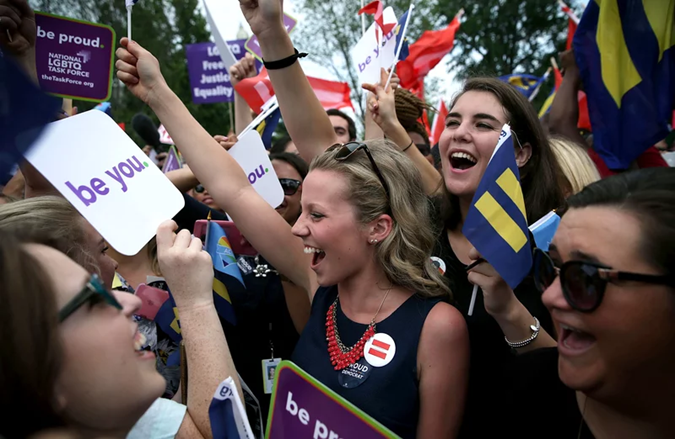
Same-sex marriage supporters rejoice outside the Supreme Court in Washington, D.C. in 2015 after the U.S Supreme Court ruled that same-sex couples have the right to marry in all 50 states. Photograph taken by Alex Wong and courtesy of Getty Images.
The struggle for women’s rights in the United States has been a long and complex journey. From the early suffrage movement to the ongoing fight for equality in the workplace, the political sphere, and beyond, women’s activism has shaped the nation’s social landscape. Though significant progress has been made—evident in milestones like the 19th Amendment, increased female political representation in government, and major legal victories for women—the battle for full gender equality is far from over. The modern feminist movement, with its emphasis on inclusivity and intersectionality, continues to challenge societal norms and fight for the rights of all women, particularly those from marginalized communities.