
By: Emerson Richards
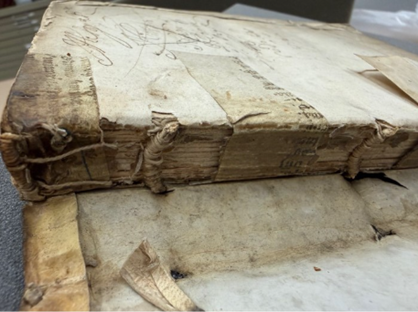
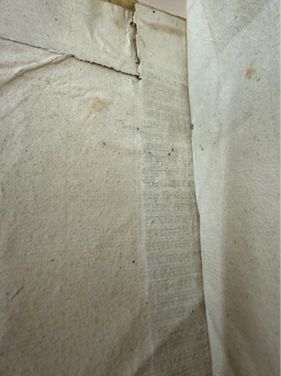
Manuscript strips appear to be from a parent book produced in the late 12th century to early 13th century, likely France or the Low Countries based on palaeographic details.
In the Spring 2026 semester, I conducted a search for hidden Medieval manuscripts in the Special Collections and Archives of Rollins College’s Olin Library. Manuscript specialists have estimated that 1 in 5 books printed from the 15th to 17th century contain fragments of medieval manuscripts, and the search for these fragments is called a binding waste survey. The Special Collections of institutions such as Yale, the Library of Congress, the Newberry Library in Chicago, Washington University in St. Louis, Syracuse University, and Western University (Ontario, CA) have fruitfully conducted binding waste surveys. So, I went on the hunt to see if we have unknown medieval material here in Central Florida.
In the late 15th through 17th centuries, print was overtaking the process commercial workshop or monastic scriptorium-production of books entirely by hand. While printed material was quicker and produced more copies, the manuscript works retained a certain aesthetic and social allure. You will notice, looking at particularly early examples of print, that the letterforms try to retain the thorny, fence-like aspect of the Gothic script used in Northern Europe from around the mid-13th century into the 15th century. You will also notice that some of the early printed work adopts a much cleaner typography that is quite legible to our modern senses—it is the ancestor of our Times New Roman and it was based on the Humanist script developed in Italy in the 15th century which sought to rebirth the Classical Roman scripts. In this sense, it failed, as what Humanist script is based on, in fact, is 9th century letterforms created under Charlemagne’s educational reform to try to increase literacy in the Holy Roman Empire.
Olin Library at Rollins College houses two books that contain artifact witnesses to this technological and cultural transition from handwritten to printed books. Alongside the cultural preference for printed books to resemble manuscripts in the early stages of this transition, there was also a tendency for early printed books to use manuscripts as part of the printed books themselves. Called ‘binding waste’ or ‘printer’s waste,’ this material is the reuse of paper or parchment (animal skin specially prepared for writing) from previous books to strengthen or serve as parts of the binding for a new book. These manuscripts can be found as strips pasted into the spine to support the structure of the book, or they are whole leaves that are used as flyleaves and pastedowns (the blank pages at the beginnings and ends of books). Sometimes, these manuscript leaves are used as the external binding of the book. This technique was used in the Middle Ages as well—you’ll find examples of manuscripts using earlier, outdated manuscripts in the same way. While sometimes, the reuse of the manuscript in the printed book appears to be utilitarian, there are many examples of the manuscript’s content resonating thematically with the content of the printed book, showing an intentionality by the printer or patron to echo medieval intellectual origins.
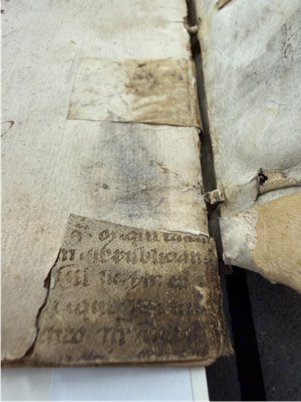
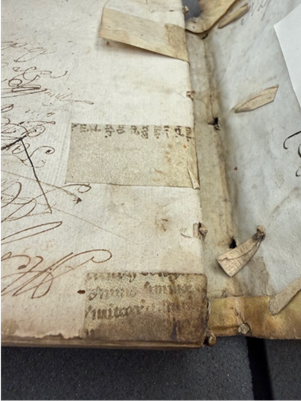
Los Emblemas de Alciato. En Lyon por Mathi Bonhome, 1549.
The first of Rollins’ binding waste fragments occurs within Los Emblemas de Alciato, printed in Lyon, France by Mathi Bonhome in 1549 (Rollins Rare BK PN 6349.A417). This is an example of mansucript binding waste used to reinforce a printed book. We find four strips from a late to 12th to early 13th century Latin manuscript produced in France or the Low Countries; the text is unidentified. I determined the date and location of the manuscript using the features of handwriting (an auxiliary science called palaeography). The letters are not a full formed dense and fused Gothic script, which would put the manuscript after around 1220, but we could also be viewing the work of a conservative scribe that wanted to retain older conventions.
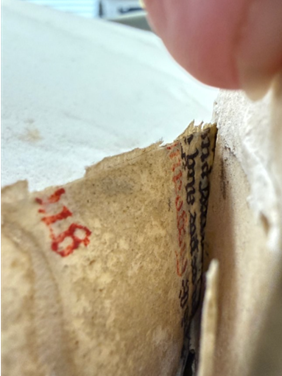
ΑΡΑΣΚΕΥΉΣ (Eusebii pamphili Euangelicae praeparationis). Lutetiae: Ex officina Rob. Stephani, Typogrami Regii, MDXLIIII (1544)
The second of Rollin’s in situ binding waste fragments is hidden in the binding of Eusebii pamphili Euangelicae praeparationis (Rollins Rare BK BR 65.E7 A63 1544), a Latin and Greek text printed in Paris in 1544. The strip of manuscript, 13 inches in length but only 1 inch in width, has been pasted over by a piece of paper, called the pastedown. The manuscript is strengthening the hinge between the text block and the cover board and only a very small portion is visible—although the ghost image of the manuscripts’ lines is visible through the paper. The manuscripts’ text is in Latin and appears to be ca. 13th century, likely a French product. The rubricated running head (text written in red along the top margin to orient the reader on what section they’re looking for) shows a visible L, which could indicate Liber (book), Lectio (reading), or Lucas (the biblical book of Luke).
My binding waste survey concluded, I was also able to catalogue the 19 stand-alone medieval fragments housed at Rollins. This collection ranges from the 13th to 16th centuries, across Europe and the Near East and includes texts in Latin, German, and Armenian. Several of these fragments were gifts of Professor Edwin O. Grover (1870-1965), Rollins’ own Professor of Books, a term inspired by the works of Ralph Waldo Emerson. In addition to the Rollins-connection, this collection also contains several ‘Ege Leaves.’ Otto Ege was a bookdealer in the mid-20th century who believed that every American ought to own a bit of Medieval European culture. His solution? Create portfolios of leaves from a selection of manuscripts and sell them to the public, dispersing the parent manuscripts across the country and world. Efforts have been made to digitally reunite the books the Ege dispatched—Denison University hosts one of these projects, and the works of Dr Lisa Fagin Davis (see, for example her article here, and her blog here) and Dr Scott Gwara in identifying the leaves has been immeasurably helpful. These previously unknown Rollins Ege Leaves can contribute to those efforts.
As a fellow bibliophile-Emerson, I am so excited to have been able to work with this collection of medieval material right here in Central Florida. I’m looking forward to the next steps in making the material digitally accessible and seeing how the students of Rollins, the Central Florida community, and the larger scholarly community of medieval manuscripts engage with this newly catalogued medieval material.
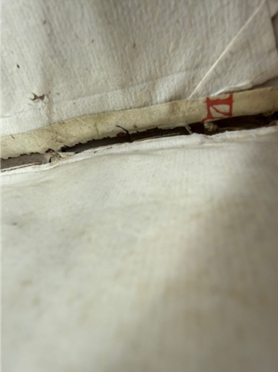
Manuscript strip appears to be from a parent book produced ca. 13th century, likely France. Running head somewhat visible with L (Liber, Lectio, Lucas)