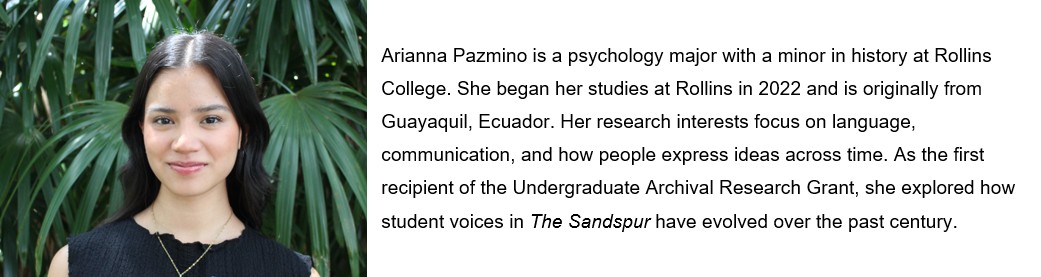
Arianna Pazmino
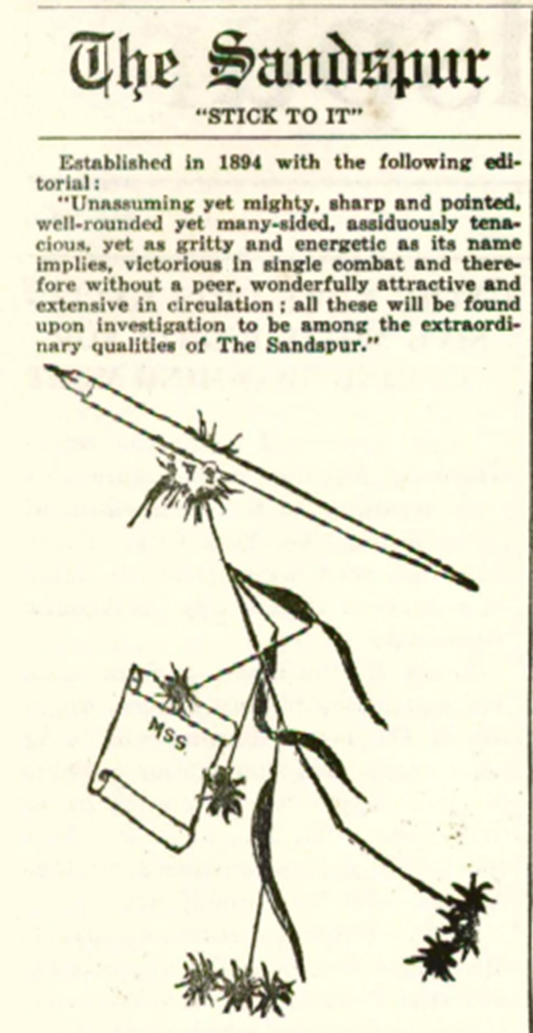
Since its first issue in December of 1894, The Sandspur has been the oldest continuously running student newspaper at Rollins College. Its legacy reflects the voices of generations of students, serving as a record of the evolution of student writing and ideals. What began as a literary journal featuring poems and essays gradually transformed into the student newspaper we read today. With access to decades of archived issues and more recent publications online, I began to notice that the tone of student writing seemed to shift across time.
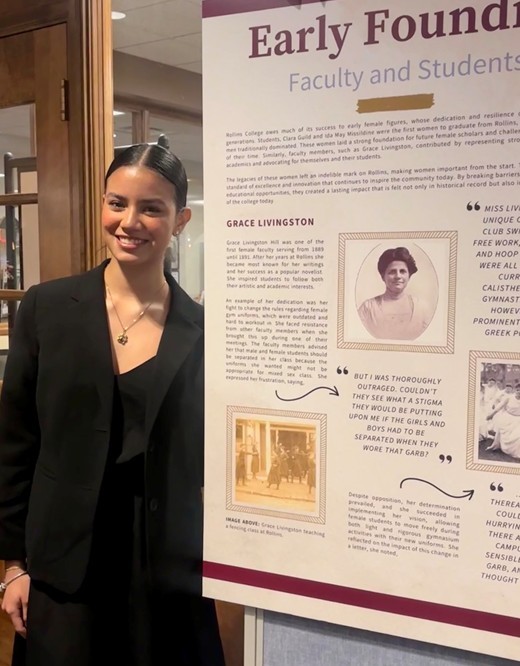
My name is Arianna Pazmino, and I am a psychology major with a minor in history at Rollins College. I was honored to be the first recipient of the Undergraduate Archival Research Grant, an opportunity that allows currently enrolled students to conduct original research using the Olin Library’s Archives and Special Collections. My journey into the archives began through Dr. Claire Strom and Professor Rachel Walton’s Public History class, where I was first introduced to working with historical materials. What started as a course requirement quickly became something more, opening the door to a deeper interest in archival research and the stories preserved within it.
The Sandspur provides a particularly unique perspective. Because it is written by students for students, it captures not only what they cared about, but how they chose to express those ideas at different points in time. What began as an exploration of content eventually revealed a broader pattern. Student editorials are more than just opinions, they are a reflection of how students communicate, argue, and engage with their college community throughout history.

Some editorials felt formal and distant, creating a separation between the writer and the reader. Others were more direct and conversational, reading almost like spoken language. This shift did not occur suddenly, but rather emerged gradually across decades of publication.
This project set out to explore that change systematically.
To do this, I analyzed editorials across a full century, selecting five editorials per decade from 1920 to 2020. For consistency, I focused on spring issues, primarily those published in March, and selected the longest available editorial in each case. The articles were then manually transcribed and analyzed, allowing for a close examination of both structure and style over time.
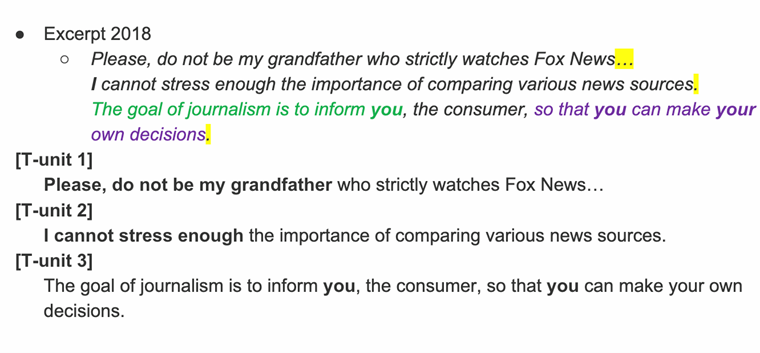
To better understand patterns that are not always visible through reading alone, I focused on a few key measurements. I counted sentence length, the number of clauses within sentences, and what are called T-units, essentially one main idea along with anything attached to it. Alongside structure, I also tracked features of personal voice, such as first- and second-person pronouns, as well as contractions like don’t or can’t. These measures allowed me to move beyond general impressions and systematically track how writing evolved.
What I found was more complex than I had anticipated. Rather than becoming simpler over time, the writing became more structurally dense, with sentences containing more embedded ideas and layers of meaning. At the same time, the tone shifted toward a more conversational style, with increased use of personal voice and direct engagement with the reader.
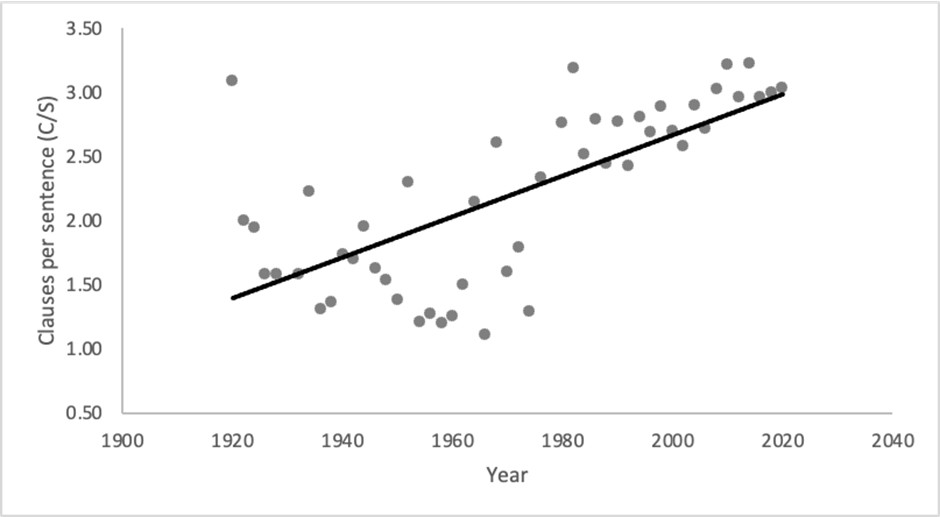
Figure 1: Clause Density over Time: Positive relationship ρ = 0.670, p < .001
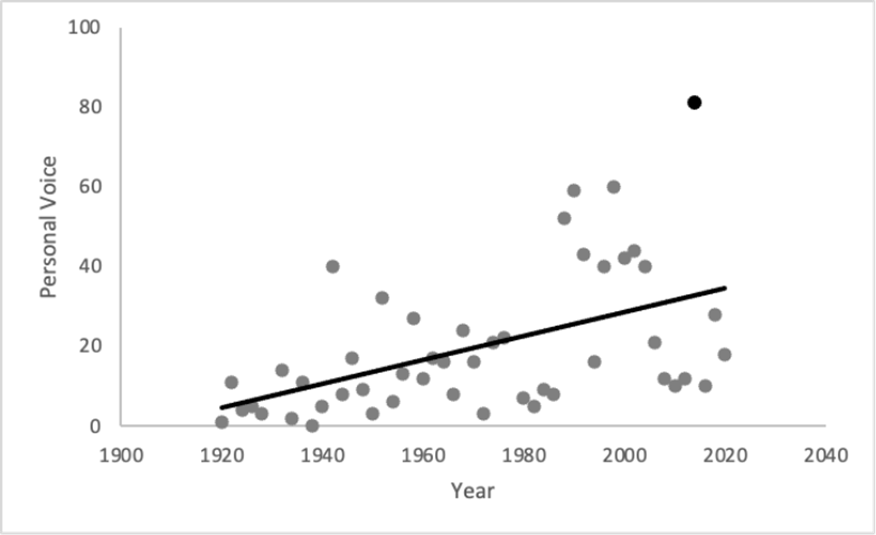
Figure 2: Personal Voice Over Time: First and Second person pronouns. ρ = 0.546, p < .001
In other words, The Sandspur editorials did not become easier by simplifying their structure. Instead, they evolved in a way that balanced complexity with accessibility. Writers continued to express complex ideas but did so in a way that felt more personal and engaging to the reader.
This means that the change in writing over time is not a shift from complex to simple writting, but rather a transformation in how complexity is expressed. Earlier writing often relied on distance and formality, while more recent writing maintains structural complexity but presents it in a more direct, reader-oriented way.
For example, earlier editorials often relied on long, formal sentences with little direct engagement with the reader. In contrast, more recent editorials may still contain multiple clauses and embedded ideas but are more likely to include phrases such as “we believe” or “you can see,” directly involving the reader in the argument. This shift shows that while the structure of writing remained complex, the relationship between the writer and reader became more immediate and conversational. Writing did not become less complex; it became differently complex.
While this study focused on how students wrote, it would also be valuable to explore what they were writing about. Changes in topic, audience, and historical context may have influenced stylistic choices across decades. Examining content alongside structure could provide a more complete understanding of how student voices have evolved over time.
What made this project especially meaningful to me is how it connects my academic interests in psychology, linguistics, and history. I have come to appreciate the importance of preserving archival materials and the role they play within the institution. The opportunity to uncover how students have expressed themselves over time, and how communication itself continues to evolve, has been a meaningful experience.
I believe this research not only contributes to our understanding of linguistic change but also highlights the importance of student voices in shaping and reflecting broader cultural shifts through language.
I am incredibly grateful for the education I have received at Rollins College and to the team at the Olin Library Archives and Special Collections for making this work possible, as well as to Dr. Jenniffer Queen and Dr. Martha Cheng for their guidance and support throughout this project. This research experience has inspired me to pursue a future career in research where I hope to carry the knowledge I have gained in my studies and discovery of the archives.