By: Ruonan Zhang, Assistant Professor, Department of Communication and Meredith Hein, Director of the Center for Leadership & Community Engagement (CLCE)
Ruonan’s “New Media and PR” course shows how Community Engagement helps students build real-world communication skills while contributing meaningful work to a local partner. It also highlights how this kind of teaching can help renew an instructor’s sense of purpose in the classroom. Meredith, as Director of the CLCE, pulls back the curtain on how faculty can connect with partners and get started.
Ruonan’s Story
I joined the Rollins faculty in 2019 as a Visiting Assistant Professor, excited to both make my mark and lay a foundation for my next professional step. The Community Engagement Program (CE) caught my attention as an exciting pedagogical opportunity. In only my second semester at Rollins, I created a new CE course “New Media and PR,” in which students created digital media and promotional materials for local community partners like the Chinese School of Tomorrow (CST) in Orlando.
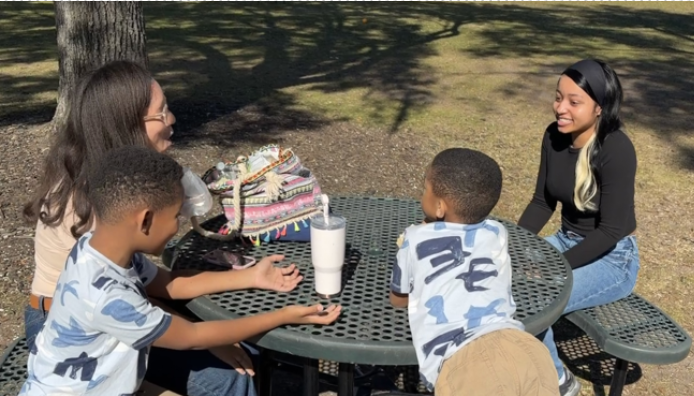
In the beginning, I thought CE was a great way for students to practice what they learned in class with a real local client. But over the years and several course iterations, I have realized how much more it offers to students, to the community, and to myself as an educator.
For students, the CE portion of the class is a bridge between campus life and “the world out there.” Students learn how to communicate professionally in new environments, how to listen carefully, and how to build trust with people they have just met.
On our first visit to CST, I remember one student who stayed quiet at first, unsure how to introduce themselves or how to ask for an interview without feeling intrusive. I often see hesitation and nervousness when students need to approach complete strangers to request an interview, but adapting to a new environment and establishing rapport are critical skills for college students to develop.
I pulled this student aside, and we practiced a simple approach together: a brief introduction, one sentence about the project, and one clear question. Still a little nervous but willing to try, the student slowly approached a parent at CST, and started to introduce herself. She was clearly nervous. Her voice started small and low, but she leaned on our rehearsed strategy and broke the ice. When the parent smiled, the student began to open up. Later in the semester, I saw that same student confidently reaching out by email, setting up interviews, and following up professionally after field trips. Moments like this remind me that confidence and communication are skills that students can build through guided practice in real time through the CE course experience.
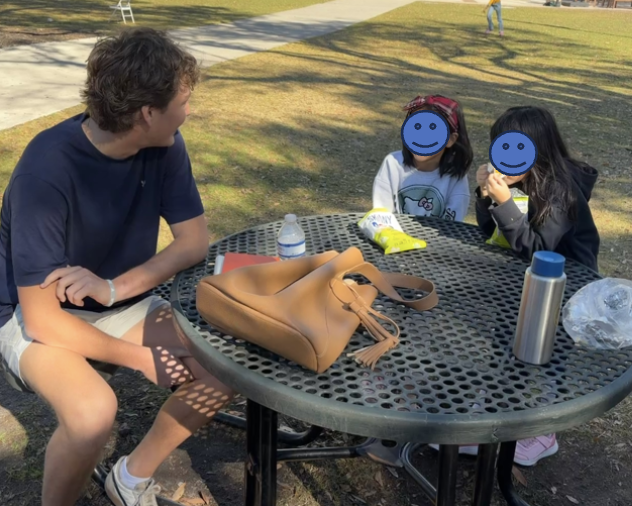
CE, when done well, also provides real impact for our community partners. Through years of collaboration, it has been a pleasure and an honor to see how CST has incorporated Rollins students’ work into their daily practices. Students’ videos have been shown at CST’s end-of-year gala, and it was a sincere joy to see the smiles those student-produced videos brought to children and parents. This long-term collaboration between CST and Rollins has become mutually empowering and beneficial, and it was moments like this that helped me make the decision to come back to Rollins after taking a Tenure Track job outside of Florida.
CE courses are one part of the foundation that makes Rollins education so special. It is way more than just practicing learned materials in classrooms under out-of-campus settings. They provide a no-filter lens for students to see how what they’re learning at Rollins is actionable in the world and can make a real impact on communities that they choose to serve.
Meredith’s Story
At its best, Community Engagement (CE) challenges the idea that expertise lives only on campus. Ruonan’s “New Media and PR” course offers a clear example of what that can look like: students learn alongside community members at the Chinese School of Tomorrow (CST), and they produce real communication materials that CST can use. In this kind of work, community partners are not “clients” in a classroom simulation. They are collaborators whose goals and knowledge shape what students make and learn.
One of the unique strengths of CE at Rollins is our relationship-centered approach. The CLCE works alongside faculty to build sustained partnerships in Central Florida rather than one-off projects. Ruonan’s multi-year collaboration with CST shows why that matters. Over time, trust builds, expectations get clearer, and the quality of student work improves. That continuity also makes it more likely that partner organizations can actually use what students create, like CST sharing Rollins students’ videos at their end-of-year gala. The strongest CE courses at Rollins grow from conversations with partners about their actual goals and needs, rather than assumptions about what students can provide. When projects are shaped together, they are more sustainable, more ethical, and more impactful for everyone involved.
For faculty who are curious but unsure where to begin, the CLCE is here to provide guidance. We would be happy to meet 1:1 to develop an individualized plan with attainable steps. A good starting point is exactly what Ruonan did: begin with a core course goal and build outward. If your course emphasizes communication, storytelling, public-facing writing, research, or creative production, we can help you identify a partner whose needs align and shape a project that students can complete within the rhythm of a semester.
Teaching a CE course requires flexibility and thoughtful planning, but as Ruonan’s story illustrates, it can also renew our sense of purpose as educators and remind students that what they are learning at Rollins is not abstract, but actionable. In CE courses, both instructors and students get the chance to experience the transformational learning at the heart of the Rollins mantra—life is for service.