This summer, Rollins hosted the Associated Colleges of the South (ACS) Teaching & Learning Workshop — a week that brought together faculty from across the consortium for immersive professional development. In the post below, colleagues Andrea Samaniego Díaz (Social Entrepreneurship) and Sirazum Munira Tisha (Computer Science) reflect on what they agreed was one of the most meaningful activities: microteaching. This practice includes presenting a short slice of a class, watching the recording, and receiving supportive feedback from colleagues. Here, they share what the experience meant for them.
Andrea Samaniego Díaz, Department of Social Entrepreneurship
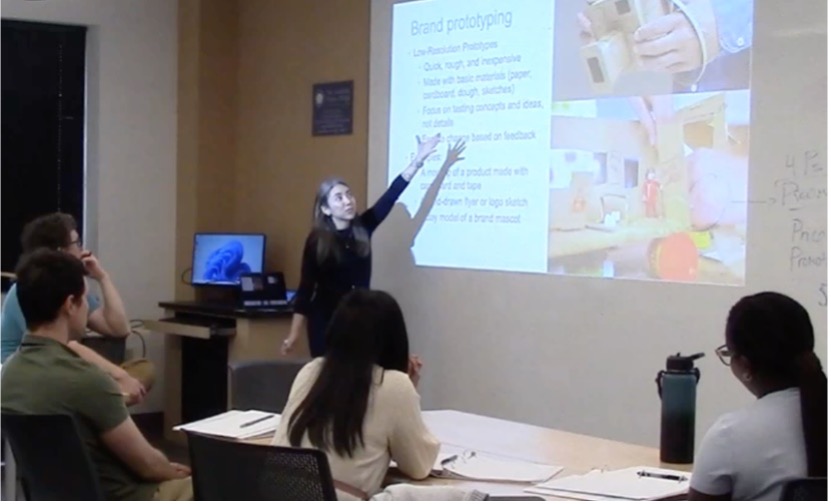
I had heard from colleagues that this workshop was one of the most valuable experiences of their academic careers, but it still exceeded my expectations. The microteaching sessions were especially eye-opening.
Watching a seven-minute recording of myself teaching was awkward at first — but incredibly insightful. I intentionally chose a moment in class that felt challenging: asking students an icebreaker question and then waiting for their responses. In the moment, the silence felt long and uncomfortable, like I should step in. But reviewing the video and hearing feedback from my colleagues helped me see that the pause wasn’t nearly as long as it felt. One colleague said they valued having time to think without pressure, while another noted that the space made the classroom feel more thoughtful and open.
There was something powerful about being seen and heard by colleagues from other disciplines. Their observations helped me reflect on tone, pacing, clarity, and engagement — all through the lens of how students might experience class. I came away reminded that silence can be a gift, and that thoughtful, non-directive feedback makes real growth possible.
Sirazum Munira Tisha, Department of Computer Science
As someone who has just finished my second year of teaching, I came into the ACS workshop eager to find ways to teach better. Microteaching turned out to be the most impactful activity for me.

At first, I was skeptical — how could seven minutes capture my teaching? And in a group with colleagues from arts, biology, business, sociology, theatre, and dance, I wasn’t sure if their feedback would apply. But I quickly realized it wasn’t about content coverage. It was about delivery and how the lesson felt from the students’ perspective. Watching my recording, I saw moments that brought laughter, places where things didn’t land, and mistakes I could work on.
Acting as a “student” in my peers’ sessions was just as valuable. I practiced giving constructive, respectful feedback, and I left with fresh classroom ideas — like using color cards to check students’ moods or starting class with a funny, topic-related meme. Beyond strategies, it was a chance to remember what it feels like to be a student again, which is something I want to carry into my classes this fall.
If you’d like to explore non-evaluative teaching observation groups — such as microteaching circles or teaching squares – reach out to the Endeavor Center at crlittler@rollins.edu or aldavis@rollins.edu.
These support spaces offer the chance to experiment, reflect, and grow together as teachers.