By: Whitney L. Coyle, Associate Professor & Chair, Department of Physics
We peer-review each other’s scholarship. We sit on each other’s thesis committees. We push back on each other’s methods and findings without a second thought. But teaching? Most of us do that completely alone. And if you’re post-tenure, you may not have had a colleague in your classroom in years. When’s the last time someone watched you teach, not to check a box, but just to have a real conversation about it?
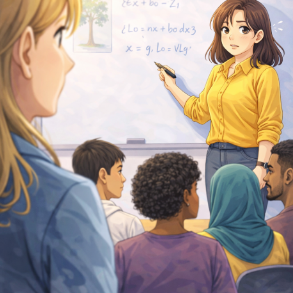
Here’s something I don’t say out loud very often: I still get nervous when a colleague comes to watch me teach. Not because I don’t know my material. The nerves come from something subtler, a worry that a pedagogical choice I’ve made deliberately and thoughtfully won’t land the way I hoped. That a colleague will walk in on a messy discussion or a derailed demo and think: is that on purpose? And honestly, some days are just not my best. But that’s exactly the point, one observation, once, under formal circumstances, gives you one data point. It’s not a picture. If observation were woven into our culture throughout the year, throughout our careers, you’d get something far more accurate, and far more useful.
But I’ve come to believe that nervousness is partly a symptom of how rarely we do this. When observation is exceptional, when it only happens under formal, evaluative circumstances, of course it feels like someone is looking over your shoulder. Of course the stakes feel high. We’ve made it strange by making it rare.
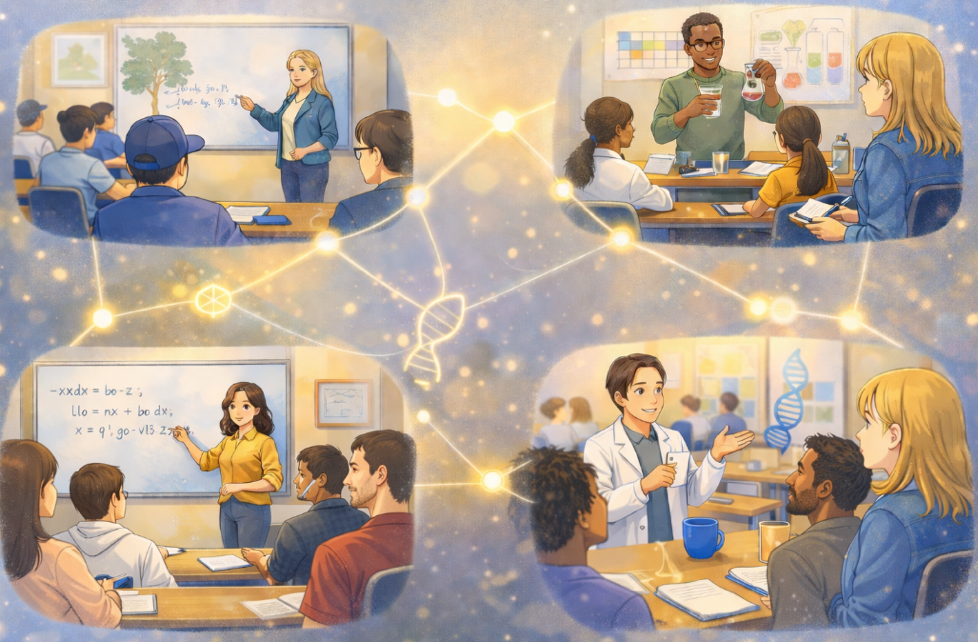
This past year I participated in the Science Division Teaching Triangle program, and it gave me a different experience of what observation can look like. When I observed a colleague’s Calculus course last fall, I didn’t go in looking for teaching tips. I went because Calculus and Physics I share a significant number of students, and I wanted to see my students in someone else’s classroom. What I found was quietly revelatory, watching them navigate problem-solving when the framing and notation differed from mine told me things about how they think that a full semester of my own class never had. I also noticed something worth stealing: my colleague’s transparency about her own thinking process. She made uncertainty look like part of the work, not a failure. I’ve been trying to do that more ever since.
And then there’s the experience of being on the other side. Someone sits near the back, sometimes writing notes without looking at you, sometimes watching the students more than the instructor, reading the room, noticing who’s engaged, who has quietly checked out. What surprised me wasn’t the written feedback. It was the conversation afterward. We get student evaluations every semester, and they matter. But students aren’t teaching experts. We are. And yet we almost never talk to each other about teaching in a real, substantive way, unless something has gone very wrong. That feels like a missed opportunity.

When our full Teaching Triangle group sat down for lunch in January, that’s exactly what happened, and it was the highlight of the whole program. Not the observation forms, not the written reports. Just a table of colleagues from Biology, Mathematics, Environmental Science, Computer Science, and Physics, talking honestly about teaching. We talked about things that rarely have a home in department meetings: how room layout quietly shapes who participates, what to actually do with student evaluations rather than just receive them, how to support early-career colleagues in ways that go beyond formal review. It was energizing in a way I didn’t expect.
Good student evaluations are wonderful. But they are not a reason to stop growing. If we make observation a normal, ongoing part of our culture, not reserved for pre-tenure reviews or moments of concern, it stops feeling like surveillance. The nervousness fades. It becomes what it actually is: colleagues who care about their craft, paying attention to each other, making all of us better in the process.
I’m still working on the nerves. But I’m more convinced than ever that the answer isn’t fewer observations. It’s more of them, for all of us, at every stage of our careers.
Would you like to join a teaching square next semester? The Endeavor Center can help. Teaching squares may be organized around a shared pedagogical interest, such as interdisciplinarity, AI integration, or dialogue across difference, but they do not have to be. Simply sharing an interest in non-evaluative teaching observation can be a great place to begin. Contact Lucy Littler at crlittler@rollins.edu for more information.
If you’d like to join a Science Division-specific teaching square, reach out to Kasandra Riley at KRILEY@Rollins.edu and Jay Pieczynski at JPIECZYNSKI@Rollins.edu.
Images in this post created with ChatGPT+.