by Wendy Hitchmough Ph.D., Emeritus Senior Lecturer at the University of Sussex
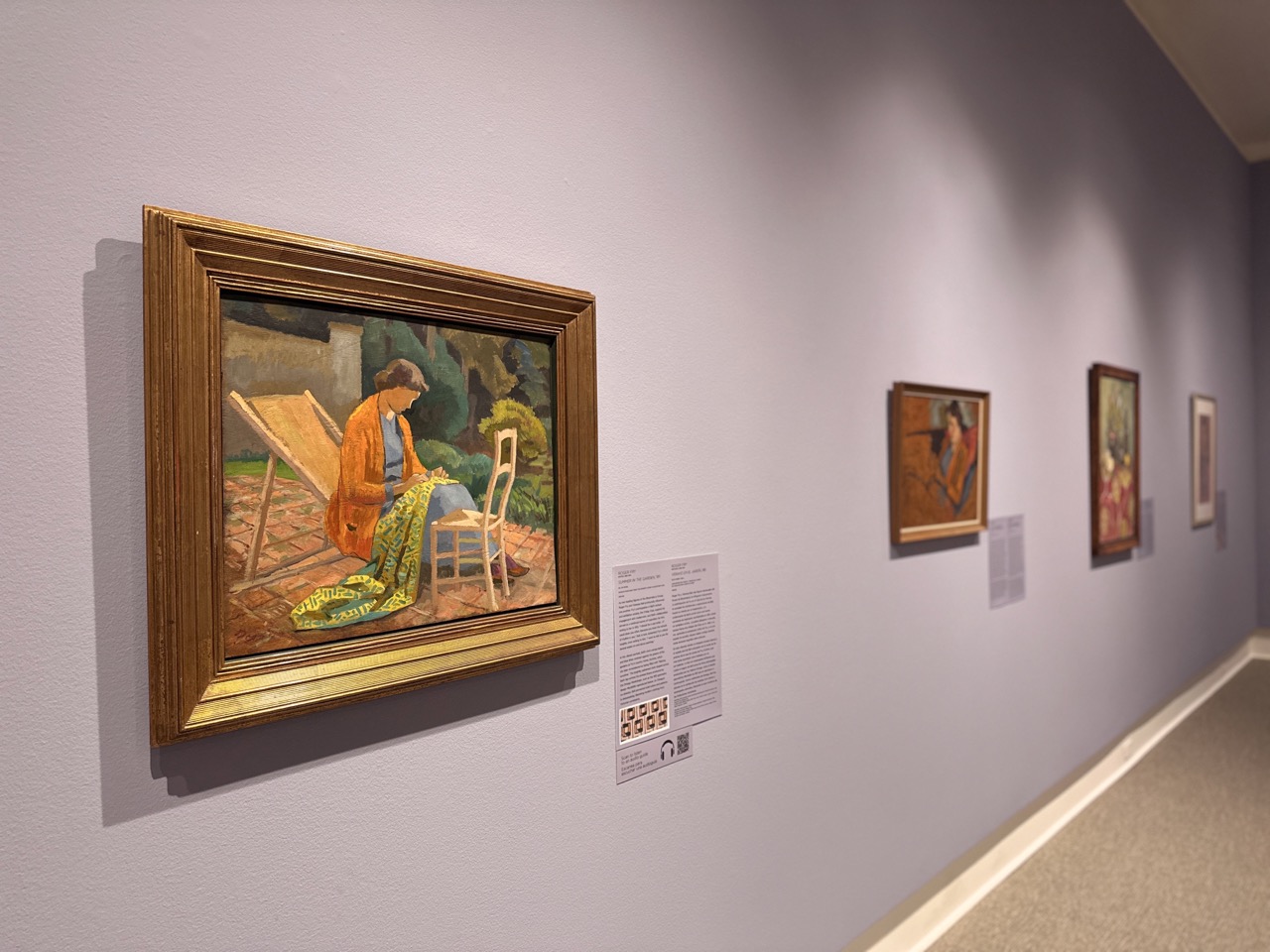
Every picture tells a story, but which story lies behind Summer in the Garden? (FIGURE 1)1 Is Vanessa Bell recovering from a miscarriage at the home of her new lover, Roger Fry? Or is she six months pregnant with the daughter she would have with Duncan Grant? We’re fascinated by Bloomsbury’s love affairs and the tangled web of family connections, friendships and sexual relationships that underpinned the group’s ground-breaking incursions into
modernism. Bloomsbury subverted the Victorian values that made marriage an inviolable institution and homosexuality illegal. It was permissive. As a circle of friends, it questioned and explored human relationships with the same vigor.

and candor that it discussed the nature of art. ‘“What exactly do you mean?” was the phrase most frequently on our lips.’ Maynard Keynes later recalled. ‘If it appeared under cross-examination that you did not mean exactly anything, you lay under a strong suspicion of meaning nothing whatever.2 Most of the men in the Bloomsbury Group had become friends at Cambridge University where an elite secret society, the Apostles, cultivated this philosophical discipline. They also reveled in gossip about each other’s sex lives. ‘The society of buggers has many advantages – if you are a woman’ Virginia Woolf later recalled in her memoir, ‘Old Bloomsbury’. The Cambridge graduates clustered around her brother, Thoby Stephen, and they began to gather on ‘Thursday evenings’ at 46 Gordon Square, the home she established with her sister, Vanessa Bell. Thoby died suddenly of typhoid fever at the age of 26, devastating the circle of friends and drawing them closer together. Vanessa married one of his closest undergraduate friends, Clive Bell, and she and Virginia were soon initiated into the ‘bawdy talk’ that the young men habitually enjoyed. ‘We listened with rapt interest to the love affairs of the buggers’. Now, Virginia wrote, there was ‘nothing that one could not say, nothing that one could not do, at 46 Gordon Square.3
Three of the paintings in the Rollins Museum of Art collection describe particular moments in Bloomsbury’s modernist approach to life and love as well as art. Two of them were painted at 46 Gordon Square and the third, Summer in the Garden, is a painting of Vanessa Bell by Roger Fry, probably painted at Durbins, the house he designed for himself, near Guildford. Dating Summer in the Garden raise interesting questions. Vanessa stayed at Durbins in June 1911 and at a cottage close by in August when she and Roger were passionately in love. She had suffered a miscarriage in April 1911 whilst on holiday in Turkey with Roger, Clive and another friend. Roger had cared for her, nursed her back to health and they became lovers. She recuperated at Durbins and that summer she and Roger began to forge a new direction for British painting.
Roger had outraged London in December 1910 with his exhibition at the Grafton Galleries, Manet and the Post-Impressionists. He was planning a follow-up, the Second Post-Impressionist Exhibition which would feature work by young British Post-Impressionists alongside iconic works by Picasso and Matisse. The intensity of Roger and Vanessa’s love affair coincided with aperiod of radical experiments in thework of both artists. ‘Nessa I should be a real artist really truly & without doubt if I could draw you often because you have this miracle of rhythm in you . . .in everything you do’, Roger wrote to her,4 ‘I imagine all your postures and how you’ll be saying things & how all round you people will dare to be themselves & talk of anything & everything & no idea of sham or fear will come to them because you’re there, & they know you’ll understand.’5 Vanessa invited him to share her studio at 46 Gordon Square and he sketched her on the black sofa that she designed: ‘I look at the drawings which . . . still do remind me of the sight of you on the black sofa’, he wrote and he included a sketch of her: ‘That’s the shape of your breast when you’re lying down. I send it because it’s one of the things you can only enjoy through me.6 They painted each other on holiday on the Isle of Wight and there was an extraordinary equality in their working relationship: ‘I did a sketch of Roger yesterday in Duncan [Grant]’s leopard manner with odd results but very like’, Vanessa wrote to Clive, ‘& today R. is doing one of me. I’ve persuaded him to try the leopard technique too & he isn’t at all happy in it, but is spotting away industriously in the hopes of getting at something in the end.7
Her vibrant portrait of Roger, influenced by paintings she had seen in Manet and the Post-Impressionists by Seurat, Signac and Cross, is in the National Portrait Gallery in London.8 The appeal of dating Summer in the Garden to this first flush of Roger and Vanessa’s enduring love is self-evident. The painting is Post-Impressionist in its bold use of color and handling of paint. A woman is sitting upright in a deckchair to stitch or examine a brightly patterned textile arranged across her knees and cascading onto a reddish-brown paved terrace. Broad brushstrokes articulate the shrubs and bushes of her garden setting, and an empty chair in the foreground is set to face her. There are photographs and paintings of Vanessa using a chair in this way as a makeshift easel but here its vacancy is arresting. She doesn’t use it to protect the fabric on her lap from the ground, and anybody sitting on it would be uncomfortably close, subjecting her to an intense scrutiny. The simplicity of the woman’s long blue dress, contrasting with a brilliant burnt orange jacket, and Fry’s use of light, make this a compelling painting. Sunshine highlights the profile of her forehead, nose and neck but her face is almost featureless, cast in shadow. The painting is undated and this absence of features, combined with the woman’s colorful clothing, make 1911 a problematic proposition. In addition, the woman appears to be pregnant.
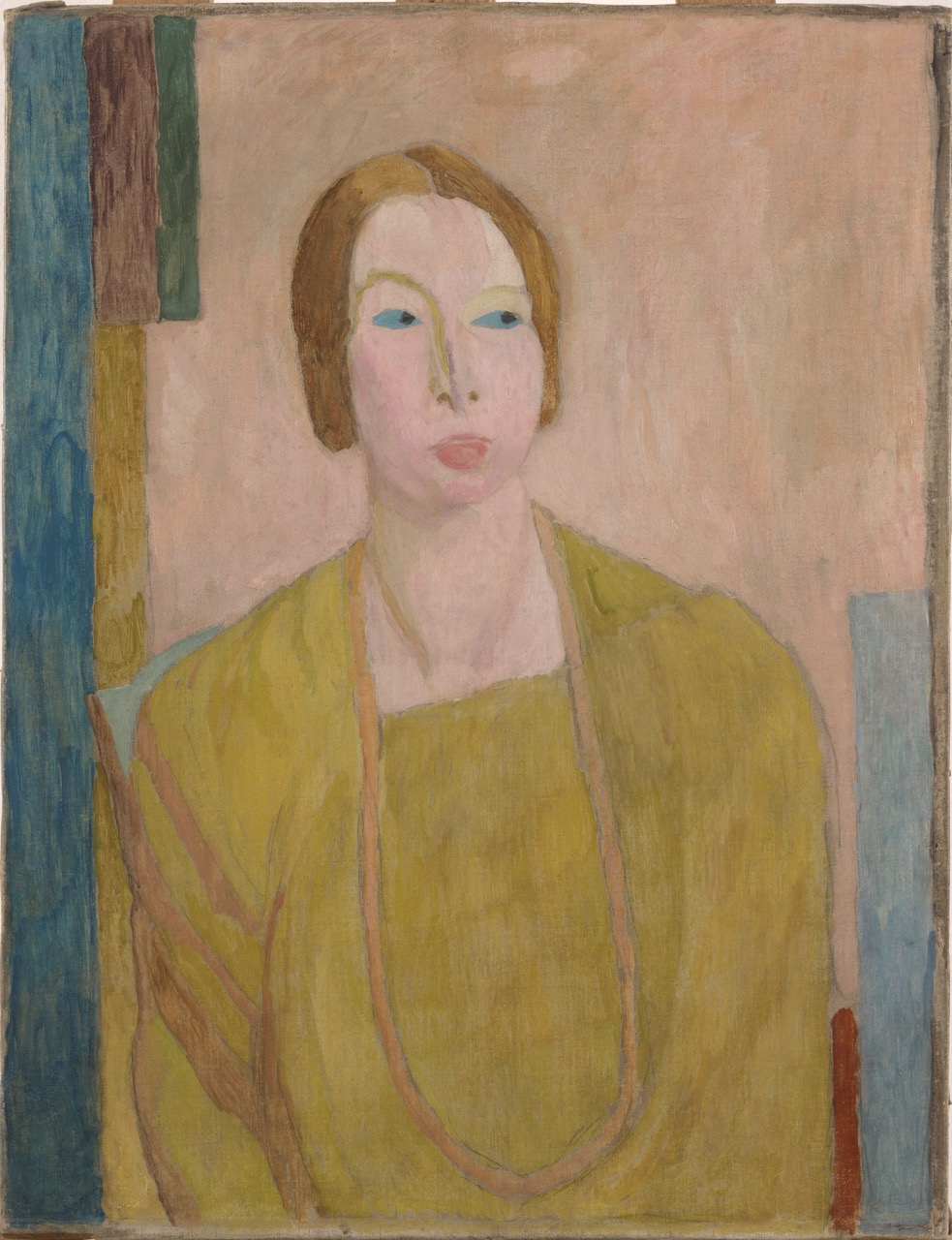
Vanessa did own an orange jacket by 1913. She complained to Clive ‘My orange jacket is getting so holey that I must have something else to wear’, but her dress is more conventional and elaborate in photographs taken at Durbins in 1911.9 She began to express her commitment to Post-Impressionism in her clothing in October 1911, buying ‘bright stockings– green & red’, and by 1915 her dress sense was radical.10 She and Roger, together with Duncan Grant, founded a design studio and shop, the Omega Workshops, together in 1913. Textiles were dyed and block printed by hand in brilliant and unconventional colors= there and when Mary Hutchinson first modelled for Vanessa and Duncan at 46 Gordon Square in 1915 she expressed her modernity by wearing a pea green outfit with a long string of yellow beads that could only have been bought from the Omega. Portrait of Mary St. John Hutchinson marks another ‘moment’ in Bloomsbury’s history (FIGURE 2).11 She was seven months pregnant when it was painted and in the first months of a love affair with Clive that would last for over a decade. Vanessa described the sitting in a letter to Roger: ‘On Friday we painted Mary . . . It is a frightfully difficult arrangement for I’m bang in front of her & everything is very straight & simple & very delicate colour. I’m making a horrid mess of it’. Mary had stayed over at Gordon Square after a play reading of Antony & Cleopatra the night before. ‘She is going to sit again this morning & I am now waiting for her & Duncan to appear.’12
By this time, Vanessa had fallen out of love with Roger and her professional partnership with Duncan had shifted into a sexual relationship that was made more complicated by his predominant homosexuality. Mary loaned them her house in Sussex so that they could spend time together and to free up a little space at Gordon Square. Clive hung her portrait ‘which looks humorously, and rather sly over the back of my chair’ he wrote to her. It ‘seems to say “Yes”, or, at any rate, “Try”’.13 It was exhibited in Vanessa’s first solo exhibition at the Omega Workshops where it was for sale for seven guineas. Roger bought it.
Roger and Vanessa’s correspondence throughout the First World War describes his dejection and jealousy as they transitioned from lovers to friends. Vanessa’s determination that this was possible, that she could cast him off as a lover and yet remain his intimate friend while staying married to Clive and living with Duncan is characteristic of Bloomsbury’s unorthodoxy. Initially, when Vanessa moved to Charleston in East Sussex with Duncan and his boyfriend, David Garnett, Roger was reluctant to visit unless Duncan was away. He visited in September 1917, bringing flowers for the garden, while Duncan was in London. They painted together in her studio and laid out a new garden path. The Breakfast Table was painted during or after a visit to Charleston the following June when he stayed at Bo Peep Cottage nearby (FIGURE 3).14 He was humiliated, he wrote, by Vanessa’s lack of affection. By now she was pregnant with Duncan’s child: ‘I don’t believe you’ve any conception how continually you ignored & overlooked me while I was at Bo Peep’ he wrote to her, but the thought of life without her was ‘too unbearable & I must go on loving you at whatever cost.15 She was candid in her letters to him, insisting that their relationship mattered to her: ‘one can force oneself not to expect or even want much more than is freely given . . . At least I have found that that is what I have to do’.16
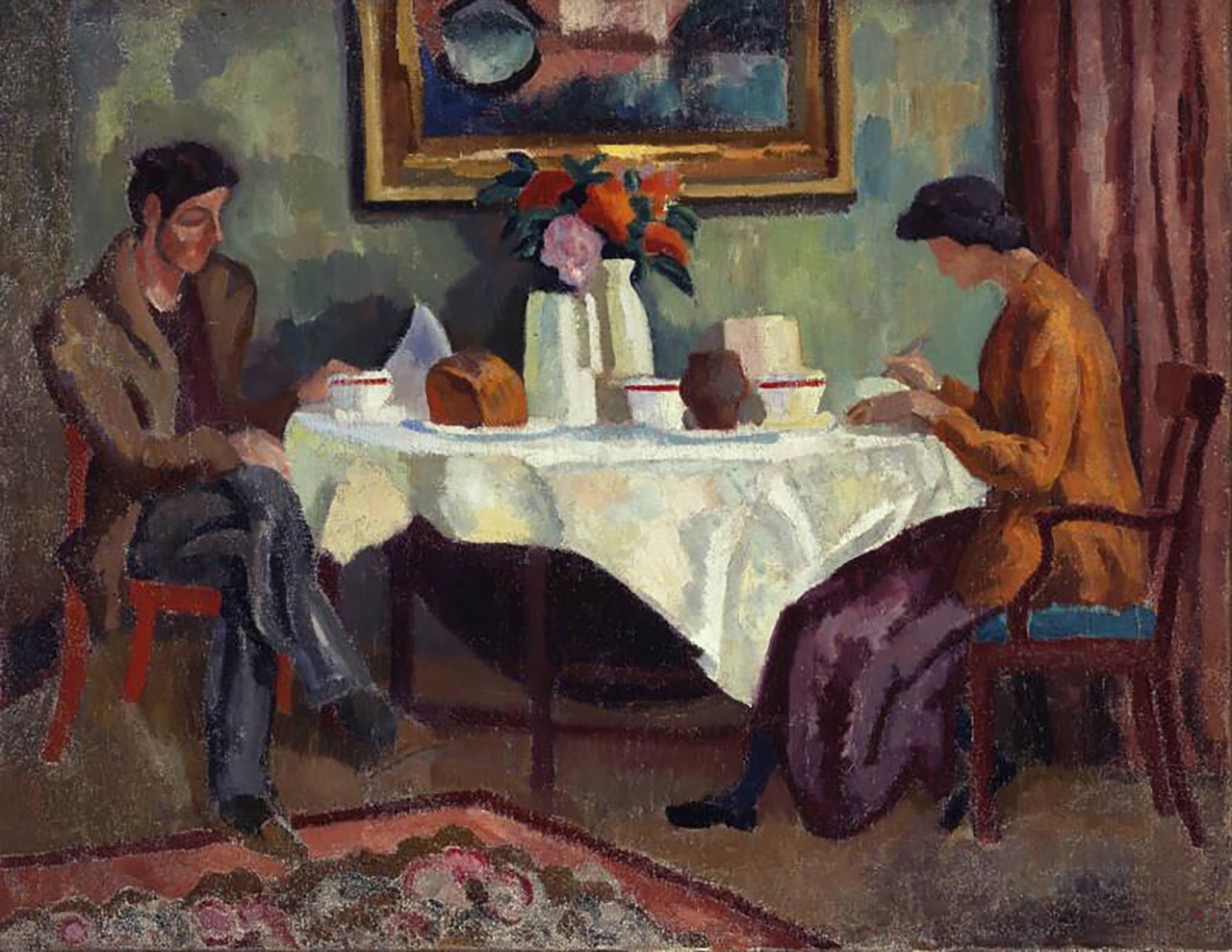
FIGURE 3 Roger Fry, The Breakfast Table, ca. 1918, oil on canvas, 28 1/32 x 36 9/64 in., Aberdeen Art Gallery & Museums, purchased with the assistance of the National Fund for Acquisitions, 1977, ABDAG000001.
StylisticallyThe Breakfast Table anticipates Summer in the Garden. Duncan and Vanessa sit opposite one another in the Garden Room at Charleston. Vlaminck’s Poissy le Pont (which Roger had included in Manet and the Post-Impressionists and Clive and Vanessa had subsequently bought) hangs between them and the table is laid with an Omega Workshops vase and jug. The artists’ avant-garde credentials are reinforced by the color-combinations of Vanessa’s orange jacket, mauve skirt and blue stockings. The profile view of her face is almost devoid of features. She stayed at Durbins soon afterwards, in September 1918, when she was six months pregnant. By now the end of the First World War was in sight and Duncan was in London. Vanessa had planned to spend a week at Durbins from 23 September before joining him there for a week or so to see the Ballets Russes and to decorate the drawing room at 46 Gordon Square where Maynard was now living.17 The decorations included painted door panels and new upholstery for the furniture in the room.18 She fell on the staircase at Charleston, however, and wrote to Virginia from Durbins that ‘after about 3 days’ with Roger, ‘it suddenly seemed as though I were going to have a miscarriage.’19 She had lost some blood, she wrote to Duncan, and the doctor was called: ‘he thought probably I was not going to have a miscarriage’ but advised her to stay in bed and rest. ‘You can imagine how happy Roger is to have me on my back again!’
Summer in the Garden is likely to have been painted during this stay, when Roger cared for Vanessa at Durbins. The textile across her lap may have been chair covers or curtains for the drawing room at Gordon Square and because the weather was unseasonably cold it was, perhaps, painted in the days before she became ill. Roger travelled to London with Vanessa on 3 October. ‘I could just lie on a sofa’ there, she wrote to Duncan. She planned to watch while he decorated the drawing room, ‘& then go back to Charleston with you.’20
A third painting in the Rollins Museum of Art collection was probably sketched during these days at 46 Gordon Square at the beginning of October (FIGURE 4).21 Wearing the same blue dress and orange jacket, Vanessa reclines, propped up against brightly colored cushions on a black sofa. Its unusual design, with the arm as high as the back, suggest that this was the sofa, designed by Vanessa that Duncan included in his semi abstract view of her studio,Interior at Gordon Square.22 He described her amidst the constant flow of visitors there in a letter to David Garnett. While he painted the drawing room for Maynard, ‘Vanessa lies on the sofa and gives advice’, he wrote. ‘Roger came to lunch and Virginia and the two Sitwells came to tea. It was a charming party.’23 The following day, they went to see Scheherazade and Duncan shared a box with Mary Hutchinson and her husband, Jack. Maynard hired an old fashioned barouche to drive Vanessa around London and they all stayed out until three in the morning at a party in Chelsea hosted by Osbert and Sacheverell Sitwell.

Roger’s oil study of Vanessa reading a letter describes a moment of quiet intimacy at 46 Gordon Square in the midst of this social whirl. In the context of Bloomsbury’s complex and radical approach to relationships, the portraits that Roger, Vanessa and Duncan made of one another, and of their friends, assume a greater intensity as modernist experiments. They are intimate investigations that assume a shared commitment to penetrating beyond appearances. They challenge conventions that a portrait, primarily, should convey likeness or status. Certainly they do not flatter. The stories that revolve around the making of these paintings illuminate the integration of Bloomsbury’s progressive work with its rebellious disregard for societal norms. They’re fascinating stories because they are about life and love. But they’re important too, because they describe modernism as an engaged process, an endeavor.

Dr. Wendy Hitchmough is emeritus senior lecturer at the University of Sussex and was curator at the Bloomsbury artists’ home, Charleston, for over twelve years. She is the author of The Bloomsbury Look and Vanessa Bell: The Life and Art of a Bloomsbury Radical.
- Roger Fry, Summer in the Garden, 1911/1918, oil on panel, 19 x 23 1/8 in., Rollins Museum of Art, Museum purchase from the Kenneth Curry Acquisition Fund, 2024.50. ↩︎
- John Maynard Keynes, ‘My Early Beliefs’ in The Bloomsbury Group. A Collection of Memoirs and Commentary, ed. S.P. Rosenbaum (Toronto, Buffalo, London: University of Toronto Press, 1995), p. 89. ↩︎
- Virginia Woolf, ‘Old Bloomsbury’ in Woolf, Moments of Being: Autobiographical Writings, ed. Jeanne Schulkind (1978; repr. London: Pimlico, 2002), pp. 55–7. ↩︎
- R. Fry to V. Bell, undated [1912], GB 181 SxMs56/1/83, RFVB 17. ↩︎
- R. Fry to V. Bell, 15 September 1912, GB 181 SxMs56/1/83, RFVB 19. ↩︎
- R. Fry to V. Bell, undated [1912], in Roger Fry, Letters of Roger Fry, vol. 1, ed. Denys Sutton (London: Chatto & Windus, 1972), pp. 357–8. ↩︎
- V. Bell to C. Bell, Tuesday [16 January 1912], GB181 SxMs56/1/25, VBCB 14. ↩︎
- Vanessa Bell, Roger Fry, 1912, oil on panel, 11 17/32 x 9 19/64 in., National Portrait Gallery, London, NPG 6684. ↩︎
- V. Bell to C. Bell, 8 January [1913], GB181 SxMs56/1/25, VBCB 81. ↩︎
- V. Bell to C. Bell, 12 October [1911], GB181 SxMs56/1/25, VBCB 20. ↩︎
- Vanessa Bell, Portrait of Mary St. John Hutchinson, 1915, oil on canvas, 31 x 21 3/4 in., Rollins Museum of Art, Winter Park, Florida. ↩︎
- V. Bell to R. Fry, Tuesday [9 February 1915], GB181 SxMs56/1/28, VBRF 119. ↩︎
- C. Bell to M. Hutchinson, 3 October 1915, Mary Hutchinson Papers, Harry Ransom Center, Box 3, Folder 3.4 ↩︎
- Roger Fry, The Breakfast Table, ca. 1918, oil on canvas, 28 x 26 in., Aberdeen Art Gallery & Museums, purchased with the assistance of the National Fund for Acquisitions, 1977, ABDAG000001. ↩︎
- R. Fry to V. Bell, 7 August and 14 August 1918, GB181 SxMs56/1/83 RFVB 142 and 143. ↩︎
- V. Bell to R. Fry, Wednesday [31 July 1918] GB181 SxMs56/1/28, VBRF 264. ↩︎
- See V. Bell to R. Fry, 6 September [1918], GB181 SxMs56/1/28. VBRF 269 ↩︎
- See V. Bell to R. Fry, 20 August [1918], GB181 SxMs56/1/28. VBRF 265. ↩︎
- V. Bell to V. Woolf, Friday [4 October 1918] Berg Collection, MSS Woolf, Manuscript box (Woolf), in: Bell, Vanessa, Folder 52. ↩︎
- V. Bell to D. Grant, Saturday [28 September 1918], Tate Gallery Archive, TGA 20078/1/44/83. ↩︎
- Roger Fry, Study of Vanessa Bell Reading (Unfinished), ca. 1912/1918, oil on board, 18 x 21 in., Bequest of Kenneth Curry, Ph.D. ‘32 ↩︎
- See catalogue entry, Duncan Grant, Interior at Gordon Square, c. 1915, oil on panel, 15 3/4 x 11 13/16 in., Tate, London, TO1143. https://www.tate.org.uk/art/artworks/grantinterior-at-gordon-square-t01143 (accessed 22March 2025). ↩︎
- See D. Grant to D. Garnett, letters postmarked 6 and 9 October, quoted in David Garnett, The Flowers of the Forest (London: Chatto & Windus, 1955), pp. 187–8 ↩︎
Explore Portrait of a Movement: A New Approach to the Bloomsbury Group
Explore Portrait of a Movement: A New Approach to the Bloomsbury Group at Rollins Museum of Art. Learn about tours in English and Spanish, virtual views and more. Admission is FREE!
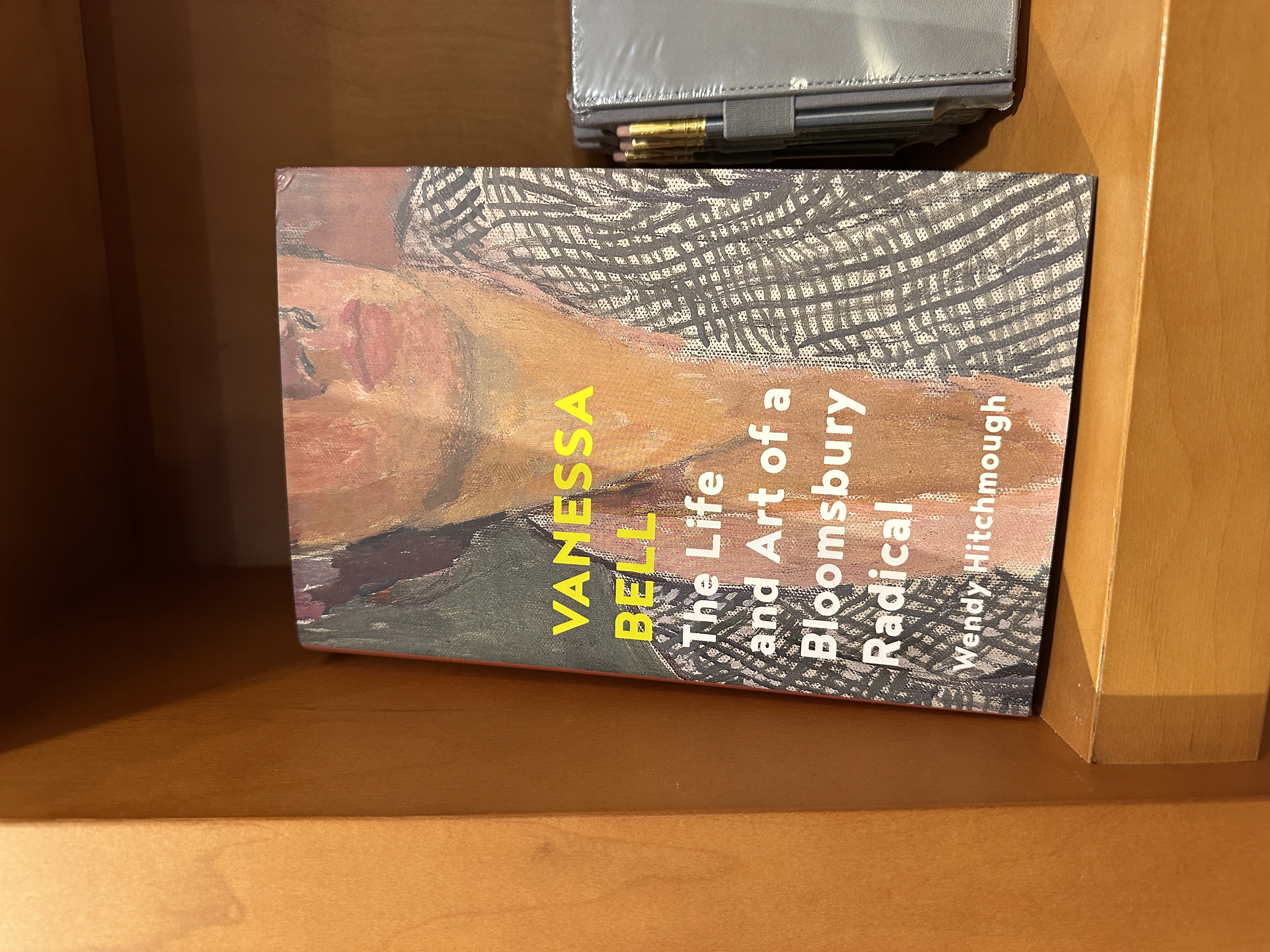
Purchase Dr. Hitchmough’s book in the Museum Shop
Purchase Vanessa Bell: The Life and Art of a Bloomsbury Radical by Dr. Wendy Hitchmough at Rollins Museum of Art through May 2026.
Free Admission to Rollins Museum of Art
Visit Rollins Museum of Art in Winter Park, Florida on the beautiful Rollins College campus and enjoy free admission Tuesday-Sunday.
Rollins Museum of Art | 1000 Holt Ave. – 2765 Winter Park, FL 32789