
Artist Trevor Paglen creates haunting images that probe the hidden structures of 21st-century politics, surveillance, technology, and AI. Right now when you visit both Rollins Museum of Art and The Alfond Inn you can view works from the Rollins Museum of Art Collection by Paglen, a recent recipient of the LG Guggenheim Award for Art and Technology. The award includes $100,000 which Paglen told ARTnews1 he will use to fund a special project.
“This is very expensive work to do. The R&D costs are insane. So this definitely helps me fund a project I didn’t know how to fund, one that’s pretty expensive. That’s really exciting.”
Trained as both an artist and a geographer, Paglen combines research, journalism, and advanced imaging technologies to explore the intersections of technology, landscape, and political power. Working frequently in collaboration with scientists and engineers, he employs telescopic photography, satellite tracking, and computational processes to document black sites, data centers, reconnaissance satellites, and drone operations. His images are often captured over vast distances, resulting in atmospheric distortions that lend them an otherworldly, disorienting quality. Through his unorthodox syntheses of disciplines—as well as his determination—Paglen strives to make the invisible infrastructure of communications and intelligence operations visible to their subjects.
Explore these works from the Rollins Museum of Art Collection that exemplify Paglen’s practice which he categorizes as an effort to understand “how to see” in an age defined by invisible systems.
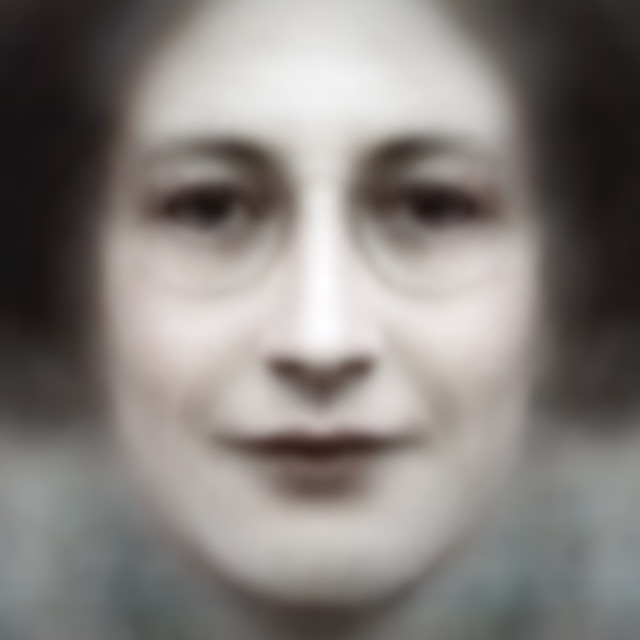
Eigenface Series (2017)
During an artist-in-residency program, Paglen collaborated with Stanford University computer scientists and software developers to explore Eigenface- a facial recognition software. The Eigenface algorithm compiles a set of photographs of a person to create an averaged “faceprint,” which can then be used to recognize that individual in future images. In his Eigenface series, Paglen investigates artificial intelligence and computer vision in facial recognition systems, focusing on the machine-generated typologies used to train computers to detect and classify human features.
Today, commercial spaces increasingly deploy facial recognition software in autonomous surveillance systems to gather data on consumers. Subtitled Even the Dead Are Not Safe, Paglen’s series expresses deep concern about the future of these technologies and their potential to reinforce systems of racism, patriarchy, and social inequality.
On view at Rollins Museum of Art through April 5, 2026
Trevor Paglen (American, b. 1974)
“WEIL” (EVEN THE DEAD ARE NOT SAFE) EIGENFACE, 2017
Dye sublimation metal print
The Alfond Collection of Contemporary Art, Rollins Museum of Art. Gift of Barbara ’68 and Theodore ’68 Alfond, 2017.6.51
Using this technology, Paglen produced portraits of four influential figures, including the French social philosopher and activist, Simone Weil (1909-1943), to emphasize that “even the dead are not safe” from that risk.
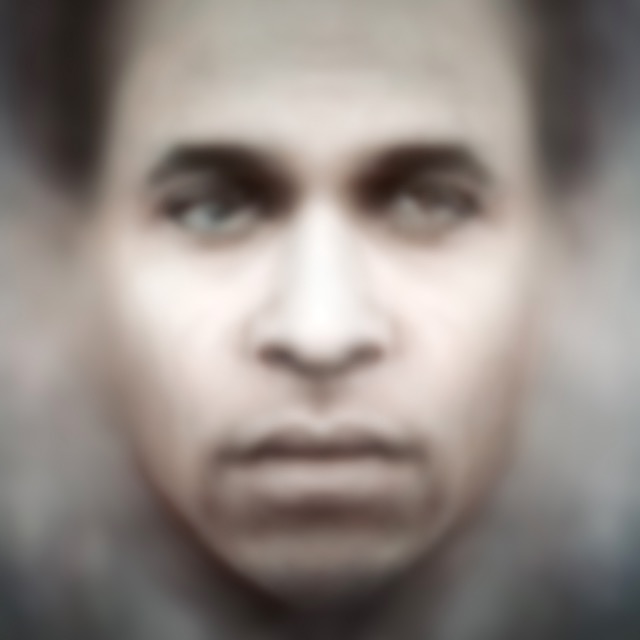
Trevor Paglen (American, b. 1974)
“FANON” (EVEN THE DEAD ARE NOT SAFE) EIGENFACE, 2017
Dye sublimation metal print, 2017 The Alfond Collection of Contemporary Art, Rollins Museum of Art. Gift of Barbara ’68 and Theodore ’68 Alfond, 2017.6.50
This portrait depicts Frantz Fanon (1925– 1961), the Pan-Africanist and anti-colonial philosopher whose writings, such as The Wretched of the Earth, are foundational to postcolonial theory.
Surveillance and Invisible Infrastructures
On view at The Alfond Inn through July 2026
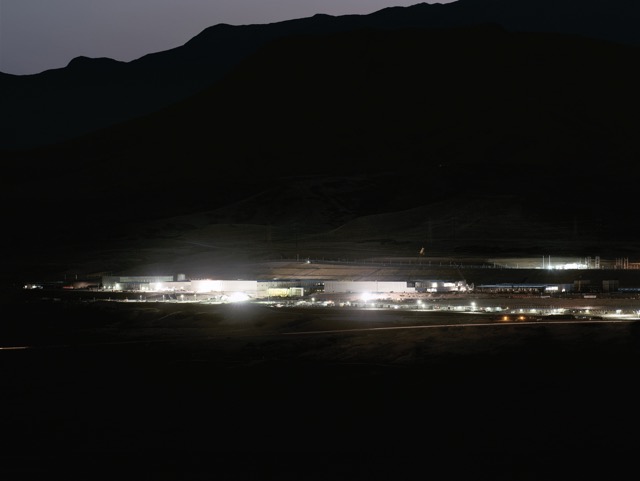
Trevor Paglen (American, b. 1974) National Security Agency Utah Data Center, Bluffdale, UT, 2012 C-print 36 x 48 in. The Alfond Collection of Contemporary Art, Rollins Museum of Art. Gift of Barbara ’68 and Theodore ’68 Alfond, 2013.34.79 © Trevor Paglen
Paglen’s meticulously researched means of visual representation provide ways of understanding the world around us aesthetically, as well as physically. Often in collaboration with scientists, Paglen has developed astronomical techniques, telescopic cameras, and computer-controlled motorized tripods to capture and document the secret installations and hardware of the U.S. military industrial complex, in essence making visible the increasingly opaque arena of power and politics. The sites are restricted and remote, and the satellites are in deep space, thus Paglen’s images are shot over tremendous distances and register otherworldly atmospheric distortions.
Overhead of NSA, 2013
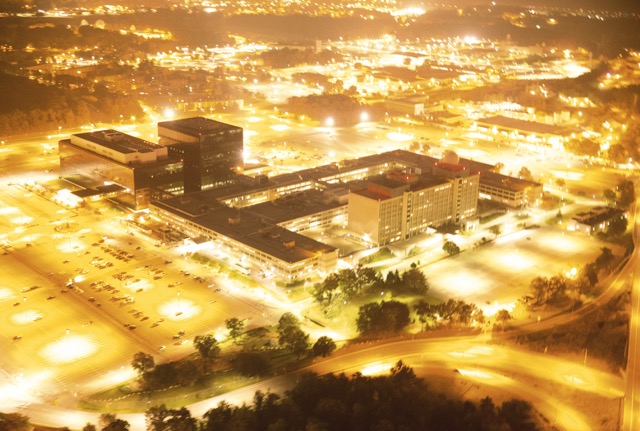
Trevor Paglen (American, b. 1974) Overhead of NSA, 2013
C-print 35 5/8 x 53 in.
The Alfond Collection of Contemporary Art, Rollins Museum of Art. Gift of Barbara ’68 and Theodore ’68 Alfond, 2013.34.149 © Trevor Paglen
Following Edward Snowden’s 2013 expose of the US government’s surveillance programs, Paglen noticed a lack of visual representation of how these operations manifested themselves in the physical world—both in the leaked Snowden files and in the media scrutiny that followed. Paglen took on the project of providing the public with an updated visual representation of the US intelligence community. The first of the three photographs in this series, Overhead of NSA, is one of the nighttime images Paglen captured from a helicopter in Fort Meade, Maryland, showing the National Security Agency’s boxy compound ringed by parking lots. In December 2013, Overhead of NSA was featured on the centerfold of Time magazine, as verification of the government’s secret surveillance program.
The Last Pictures/EchoStar XVI Launch and Preliminary Orbit (2012)
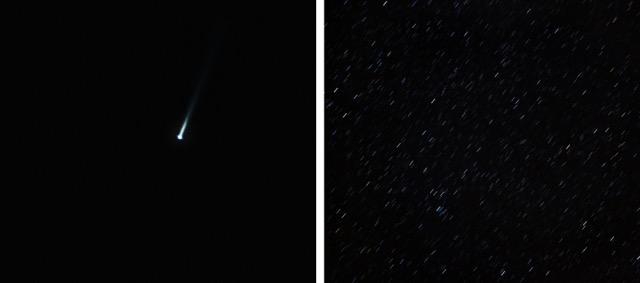
Trevor Paglen (American, b. 1974)
The Last Pictures/EchoStar XVI Launch and Preliminary Orbit, 2012
C-prints 38 x 42 1/2 in.
The Alfond Collection of Contemporary Art, Rollins Museum of Art. Gift of Barbara ’68 and Theodore ’68 Alfond, 2013.34.81 © Trevor Paglen
Paglen’s diptych The Last Pictures/EchoStar XVI Launch and Preliminary Orbit (2012) in effect documents his latest project, The Last Pictures. Developed over the course of four years in collaboration with artists, philosophers, and scientists, Paglen’s question was how to best summarize human history and culture and then preserve it in such a way as to outlast Earth itself. His solution was to select 100 representative photographic images, some shot by the artist, but most sourced from archives. These photographs were micro-etched onto a silicon disk that was encased in a gold-plated medallion. This high-tech artifact was attached to an EchoStar communications satellite that launched from the Baikonur Cosmodrome in Kazakhstan. Its orbit is 18 times farther from Earth than that of most satellites,
Untitled (Reaper Drone), 2012

Trevor Paglen (American, b. 1974)
UNTITLED (REAPER DRONE), 2012
c-print, ed. 3 of 5 (2 APs)
The Alfond Collection of Contemporary Art, Rollins Museum of Art. Gift of Barbara ’68 and Theodore ’68 Alfond,
2013.34.082
In Untitled (Reaper Drone), Paglen presents the viewer with a seemingly serene view of the sky at the change of day. Only through the title of the work, are we prompted to look more closely at the image. We find this almost invisible mark, a drone mid-flight. It is significant that Paglen is able to capture the highly controversial aircraft, but also that he calls attention to our general oblivion to the objects that are perennially orbiting our world, documenting not only military concerns, but civilian life as well.
The Last Pictures (The Narbona Panel / Humans Seen Through a Predator Drone) (2012)
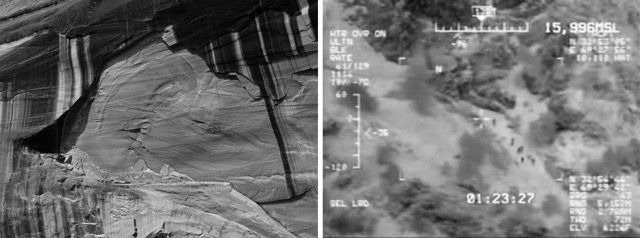
Trevor Paglen (American, b. 1974)
THE LAST PICTURES (THE NARBONA PANEL, HUMANS SEEN THROUGH A PREDATOR DRONE), Ed. 1 of 5, 2012
Gelatin silver print
The Alfond Collection of Contemporary Art, Rollins Museum of Art. Gift of Barbara ’68 and Theodore ’68 Alfond, 2013.34.80
In collaboration with experts at MIT, Paglen developed a unique silicon chip in which they etched 100 photographs shot by the artist and drawn from archives. In 2012, the chip containing The Last Pictures was attached to communications satellite EchoStar XVI and launched into orbit from Kazakhstan. The images shown here capture contested sites—the Narbona Pass, a break between two mountains in New Mexico named after a Navajo leader who defeated a foreign invasion, and a surveillance view of immigrants crossing the US/Mexico border. With the aid of technology, these images will outlast our time on Earth and will speak to our impact on the planet to those who find them.
- Greenberger, Alex. “Trevor Paglen Wins $100,000 LG Guggenheim Award for Art and Technology.” ArtNews, 17 Mar. 2026, Read the article ↩︎

Trevor Paglen Wins $100,000 LG Guggenheim Award for Art and Technology
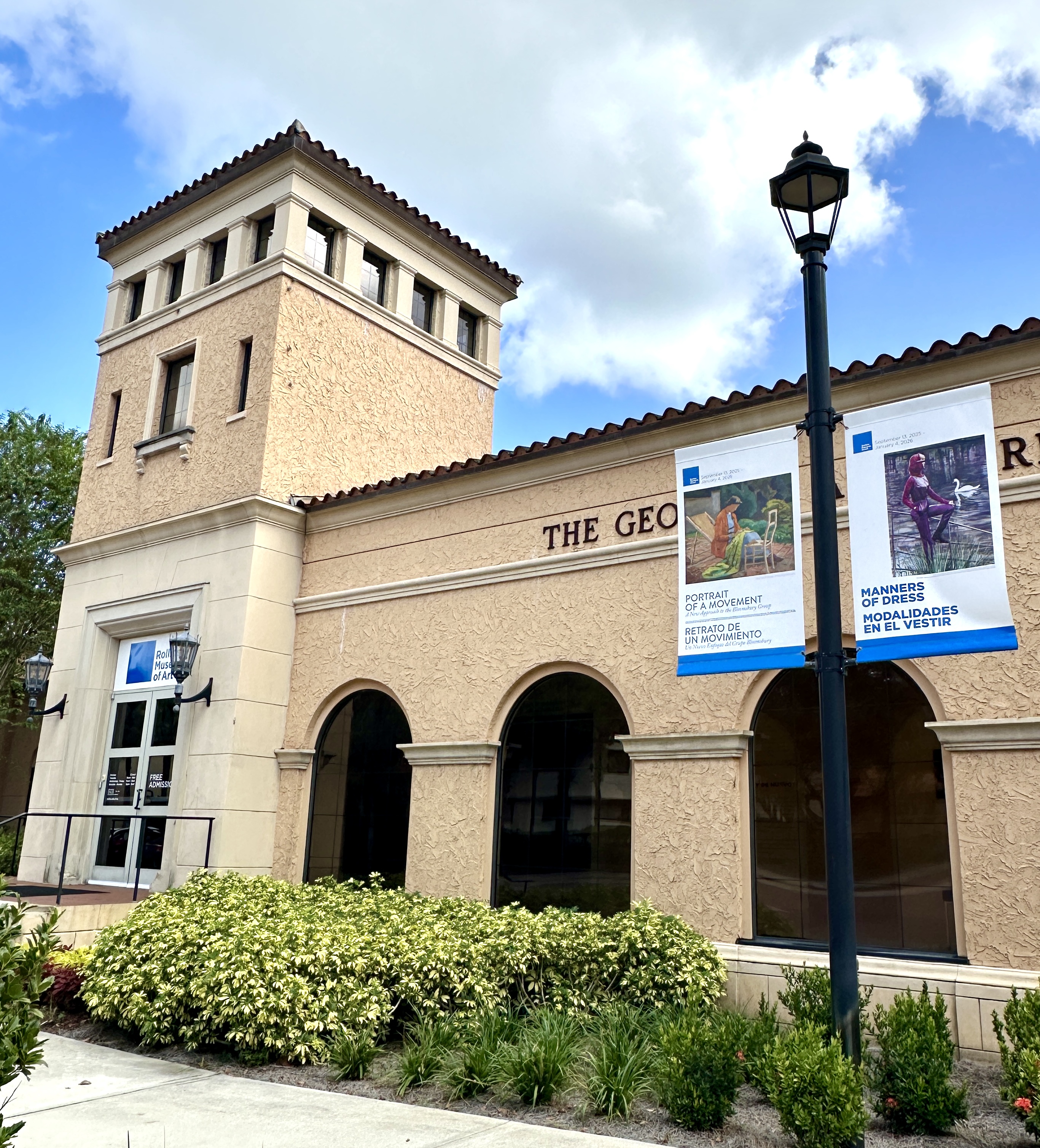
Visit Rollins Museum of Art
Admission is Free Tuesday-Sunday. Don’t miss Art at the Alfond Inn