Rachel Winter | Director, Strategic Communications MA Program; Lecturer, Communication Studies
2026-27 Rollins AI Faculty Fellow, Social Sciences Applied
Like any new technology, developments in generative AI are accompanied by a host of complex social issues. There are legitimate concerns about access, equity, and consequences for the electrical grid, the water supply, and the increasingly changing climate. Meanwhile, we must contend with the fact that, should we refuse to leverage the technology, we (and our students) will be left behind.
In the field of communication specifically, we are faced with preparing students to succeed in a workplace where messages between humans are increasingly mediated through generative AI. Our students are likewise navigating this paradigm shift, trying to balance the need for technical preparation with their ethical obligations to their fellow humans. For me, some of the most rewarding work around AI involves embracing this grey area.
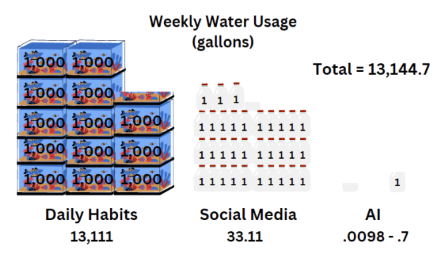
Before encouraging students in my Social Media Communication course to experiment with using AI to generate example social media posts, I start with a lesson on AI and water usage. Participants must calculate their water footprint based on daily activities, social media scrolling and, finally, their generative AI habits. Students who may use AI uncritically must consider their contribution to the world’s water bankruptcy, while those resistant to AI-use due to its environmental impact must confront the fact that their water footprint related to their Amazon shopping habit is much, much larger.
Navigating the nuance surrounding generative AI with my students helps put this technology into conversation with human developments throughout history that have had neither a wholly positive, nor a wholly negative, impact on the world. For example, discussions of AI add a new dimension to my existing lessons on copyright and remix in my graduate Web Analytics and Social Media Metrics course as we explore the topic of where the data used to train AI comes from and how this complicates (and violates) copyright. Similarly, discussions of the biased results generated by search engines now encompass an exploration of whose voices are most prevalent in the data used to train AI and therefore most likely to influence the results produced.
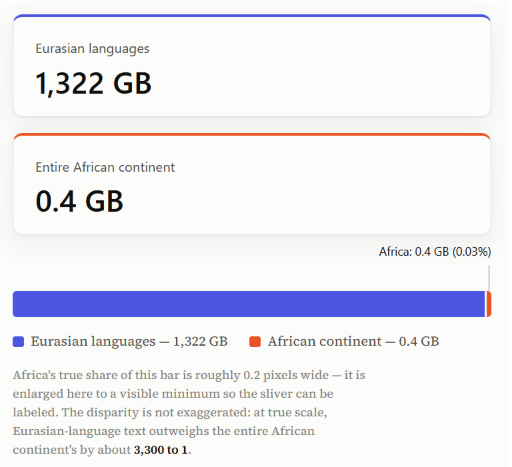
(from: https://medium.com/@wasowski.jarek/google-called-it-clean-inside-was-4chan-training-data-60dd4fc733e6; image generated by Claude)
For me, the question isn’t whether to use AI in the communication classroom. It’s how to design activities that facilitate critical engagement with AI as a new tool.
Communication technologies are constantly changing, so students need to learn how to learn to use new tools. And the fact that I am actively learning a new tool in front of them presents a valuable opportunity to model the processes and mistakes they will encounter.
Sharing the discomfort of learning with my students will hopefully allow them to more meaningfully engage in discussions where they don’t feel I already hold all the answers. In time, we can determine, together, how to adapt to using AI, how to question its results, and when a human approach is needed in the field of communication studies.